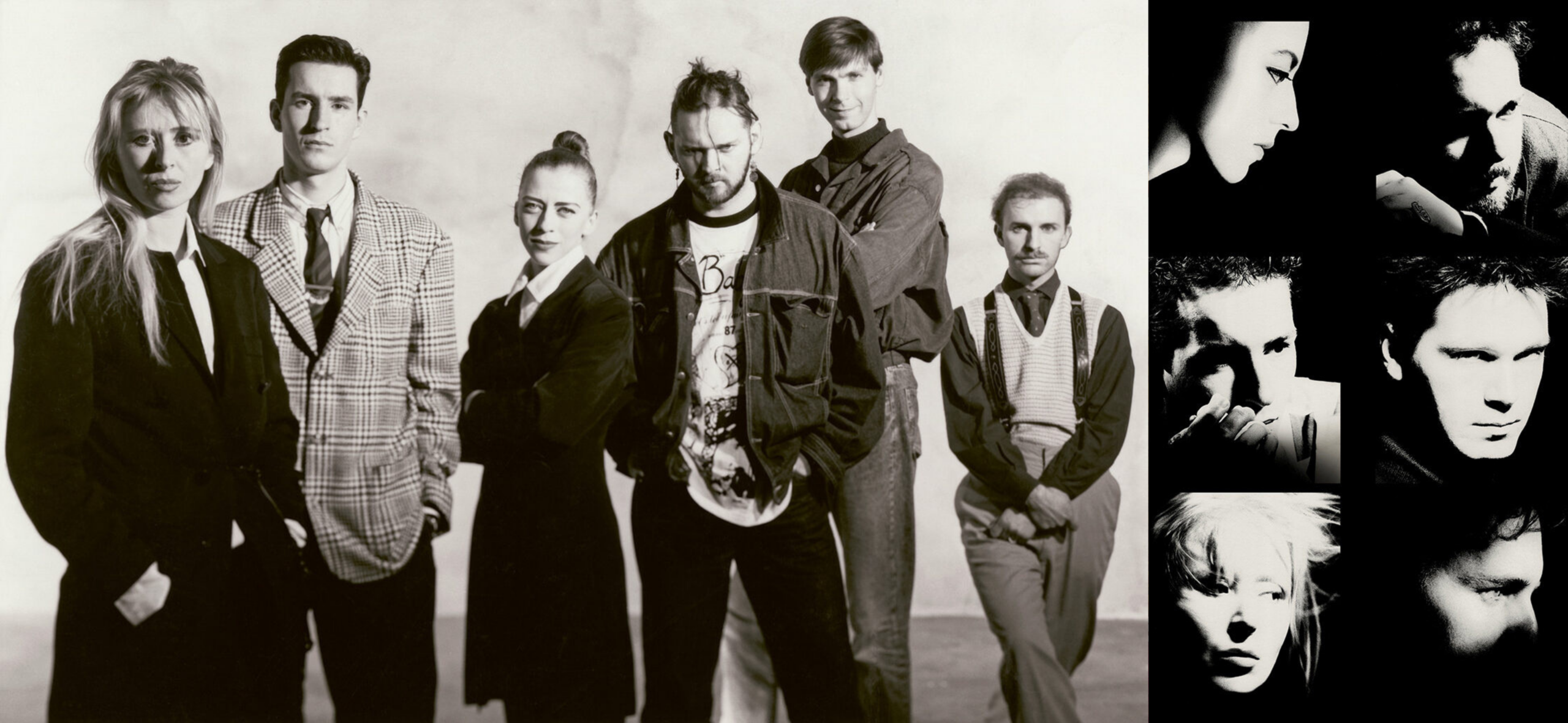

In 1986, six young Belgian designers travelled to London with their individual collections and returned with an identity that would follow them for the rest of their careers. Four decades later, a major exhibition in Antwerp revisits their extraordinary emergence, the differences that defined their work and the creative independence that made their influence so enduring.
Six designers, one city and a name none of them had chosen. The story of the Antwerp Six has become one of fashion’s most frequently repeated origin stories, often condensed into a journey to London in 1986 and the unexpected international attention that followed. Yet the familiarity of that account can obscure something fundamental. Dirk Bikkembergs, Ann Demeulemeester, Walter Van Beirendonck, Dries Van Noten, Dirk Van Saene and Marina Yee were not developing a shared aesthetic, nor were they attempting to establish a unified fashion movement. They were six individuals with different ambitions who happened to emerge from an unusually fertile creative environment.
Their appearance at the British Designer Show transformed the international perception of Belgian fashion. Until then, Antwerp had little of the institutional visibility associated with Paris, Milan or London. The success of the six designers introduced a different possibility, demonstrating that a distinctive fashion culture could develop outside the industry’s established centres and attract international attention without adopting their conventions.
Forty years later, the MoMu – Fashion Museum Antwerp is examining that history through The Antwerp Six, a major exhibition running from 28 March 2026 to 17 January 2027. The first official exhibition dedicated to all six designers, it brings together their work and archival material to explore their shared beginnings and subsequent individual careers. More importantly, it offers an opportunity to reconsider the significance of their breakthrough beyond the mythology that has accumulated around it.
Antwerp before 1986
The emergence of the Antwerp Six was closely connected to the fashion department of the Royal Academy of Fine Arts Antwerp, where the designers studied in the late 1970s and early 1980s. Their education took place at a moment when fashion was undergoing significant cultural changes. Punk, Japanese avant-garde design and the experimental energy of London were challenging established ideas of elegance, while designers increasingly approached clothing as a means of expressing individual perspectives rather than following seasonal conventions.
Antwerp offered a different environment from the major fashion capitals. Its relatively modest international profile meant that students were not surrounded by the same commercial structures or expectations that shaped fashion education elsewhere. This did not automatically produce originality, but it created conditions in which designers could develop personal approaches without immediately having to reconcile them with the demands of a large industry.
The Academy’s training emphasised drawing, technical knowledge and the development of a coherent design identity. Under the influence of teachers including Mary Prijot, students were encouraged to take clothing seriously as a creative discipline. The designers who would later become the Antwerp Six absorbed this education in different ways, translating their interests into collections that could be dramatically opposed in appearance yet equally deliberate in their construction.
Their development was also supported by a broader network of photographers, stylists, retailers and other creative figures. Antwerp’s emergence as a fashion centre was not simply the result of six exceptional graduates. It depended on an environment capable of recognising their work, helping them present it and connecting their ambitions with an international audience.
The exhibition’s curatorial approach places considerable emphasis on these beginnings. Rather than presenting the designers exclusively through their most celebrated collections, MoMu examines the period during which their individual identities were taking shape. Drawings, photographs, invitations and rarely seen archival documents help reconstruct a creative culture that existed before the international attention arrived.
London, 1986
The journey to London has acquired an almost legendary place in fashion history. The six designers travelled together to the British Designer Show, bringing collections that were strikingly different from one another. Their presentation was not the result of an elaborate international strategy, and they arrived without the commercial recognition enjoyed by established European fashion houses.
Geert Bruloot, who played an important role in supporting the designers and is involved in the anniversary exhibition, has described the London appearance as an opportunity shaped by circumstances rather than a carefully calculated campaign. Buyers and journalists began to discover the Belgian designers, whose unfamiliar names and shared city of origin encouraged the international press to identify them collectively. The designation Antwerp Six gradually became inseparable from their work.
The attention was significant because it did not depend on a common look. The designers presented different interpretations of fashion, from Demeulemeester’s exploration of tailoring and romanticism to Van Beirendonck’s provocative use of colour and imagery. What interested the industry was not the arrival of a new uniform but the discovery of several compelling creative identities emerging from the same place.
Their success also challenged the geography of fashion. The international system remained heavily concentrated around a small number of cities, each associated with particular forms of design, production and cultural authority. Antwerp’s emergence demonstrated that these established centres did not possess a monopoly on innovation. A designer could develop an independent language elsewhere and still find an audience among influential buyers and editors.
In the years that followed, the six pursued separate careers, presenting collections under their own names and developing increasingly distinct reputations. The label continued to provide a useful point of reference, but it also created an enduring misunderstanding, suggesting a degree of aesthetic unity that had never existed.
Six distinct signatures
The most revealing aspect of the Antwerp Six is the distance between their individual practices. Their shared education and early international exposure are undeniable, yet their work resists the idea of a single Belgian style.
Ann Demeulemeester
Ann Demeulemeester developed a vocabulary of elongated silhouettes, fluid tailoring and an often monochromatic palette. Her work explored the relationship between masculine and feminine clothing without treating either as a fixed category. Shirts, waistcoats, jackets and loosely draped fabrics became elements of a wardrobe in which precise construction coexisted with an apparently effortless attitude.
Her designs are frequently associated with poetry, music and romanticism, but their enduring quality also lies in their treatment of proportion. A jacket might appear familiar until its cut altered the relationship between shoulder and waist, while an asymmetrical layer could transform the movement of an otherwise restrained silhouette. Demeulemeester’s approach made emotional expression possible through relatively subtle decisions about shape, texture and the way garments were worn.
Dries Van Noten
Dries Van Noten followed a different direction, developing an exceptional command of colour, print and textile combinations. His collections often brought together references that might initially appear incompatible, using fabric and proportion to create unexpected harmony. Historical textiles, floral motifs, tailoring and elements drawn from different cultural traditions could coexist within a single look without losing their individual character.
His work demonstrated that experimentation did not necessarily require the rejection of familiar clothing. A coat, shirt or pair of trousers could remain recognisable while becoming something distinctive through material, colour or styling. Across his career, this balance between creativity and wearability helped establish one of the most influential independent design practices in contemporary fashion. His departure from the creative direction of his namesake label in 2024 also marked the end of an unusually long period of personal continuity within the luxury industry.
Walter Van Beirendonck
Walter Van Beirendonck embraced a far more confrontational visual language. His collections combined exaggerated proportions, vivid colour, graphic imagery and references to club culture, technology and social identity. Humour was often central to his work, although the playful appearance of his garments could conceal pointed commentary on sexuality, politics and the body.
His influential W.&L.T. collections during the 1990s demonstrated how fashion could engage with youth culture without simply reproducing streetwear conventions. Van Beirendonck treated clothing as a space for visual experimentation and cultural criticism, developing a practice that remained recognisably his own while continually responding to contemporary concerns.
Dirk Bikkembergs
Dirk Bikkembergs explored masculinity through clothing influenced by military uniforms, physical strength and athletic performance. His work frequently emphasised the structure of the male body, developing a visual identity that combined functional references with a highly controlled approach to silhouette.
Over time, his interest in sport became increasingly prominent, contributing to an early dialogue between luxury fashion and athletic culture. His work helped challenge the separation between formal menswear and clothing associated with physical activity, anticipating developments that would become increasingly visible throughout the following decades.
Dirk Van Saene
Dirk Van Saene approached fashion with an interest in irony, traditional dressmaking and the conventions of femininity. His collections often questioned familiar ideas of taste and refinement, introducing unexpected details or deliberately awkward combinations that disrupted conventional expectations of elegance.
His work was closely connected to his wider artistic practice, with an interest in painting and the expressive possibilities of materials. Rather than developing a highly recognisable commercial formula, Van Saene maintained a more exploratory relationship with fashion, using garments to examine the assumptions that shape how clothing is designed and perceived.
Marina Ye
Marina Yee’s practice was particularly concerned with the emotional and material qualities of existing clothing. Her interest in reconstruction and the reuse of garments challenged conventional distinctions between the new and the old, treating traces of previous use as part of a design’s character rather than imperfections to be concealed.
Yee followed a less commercially visible path than some of her contemporaries, working across fashion, art and independent creative projects. Her approach has acquired renewed relevance as the industry has become more attentive to material waste, repair and the possibilities of reworking existing garments. Her death in 2025 gives the anniversary exhibition additional poignancy, particularly as she had been closely involved in its development.
Taken together, these six approaches reveal how misleading it would be to identify the Antwerp Six through a single aesthetic. Their significance lies partly in the fact that they expanded fashion in different directions, demonstrating that creative independence could take the form of romantic tailoring, textile experimentation, provocative imagery, athletic references, conceptual dressmaking or reconstructed clothing.
Independent fashion culture
One of the most important consequences of the Antwerp Six’s international success was the development of a fashion culture in which individual authorship carried unusual weight. Their careers helped establish Antwerp as a city associated with experimentation, but their influence was not confined to the designers who followed them directly.
The broader Belgian fashion scene became internationally recognised for an approach that valued conceptual development, technical experimentation and personal identity. Martin Margiela, often mistakenly included among the Antwerp Six, belonged to the same wider creative generation and studied at the Royal Academy, but was not part of the six designers who presented together in London in 1986. His subsequent work contributed to the international recognition of Belgian fashion, particularly through his investigations into garment construction, anonymity and the conventions of luxury.
Later designers, including Raf Simons and Veronique Branquinho, emerged within a cultural environment already transformed by the visibility of Antwerp. Their work differed considerably from that of the original six, yet the city’s growing reputation made it easier for international observers to recognise Belgian fashion as a serious source of new ideas.
There is a risk, however, in treating Antwerp as a stylistic category. The diversity of its designers is precisely what makes its fashion culture interesting. Their approaches cannot be reduced to deconstruction, darkness or conceptual minimalism, despite the frequency with which those characteristics have been associated with Belgian fashion. The Antwerp Six themselves provide the strongest argument against such simplification, given the considerable distance between Van Noten’s textile compositions, Van Beirendonck’s graphic provocations and Demeulemeester’s restrained romanticism.
The more useful connection lies in their willingness to develop distinct identities and sustain them over time. Their work helped establish an alternative to the assumption that successful fashion must emerge from a dominant aesthetic or respond immediately to prevailing commercial expectations.
Forty years on display
MoMu’s anniversary exhibition approaches the six designers as individual figures whose careers intersected at a decisive moment. Curated by Geert Bruloot, Romy Cockx and Kaat Debo, it examines their shared educational background and the different directions their work took, bringing together garments with drawings, photographs, invitations and other archival documents. Each designer is given a distinct space, allowing the exhibition to preserve the differences between their practices rather than imposing a common aesthetic.
This decision is particularly significant for an exhibition dealing with designers who have acquired almost mythical status. A conventional retrospective could easily become a sequence of celebrated garments, reinforcing familiar images without explaining how they developed. MoMu instead places importance on the creative processes behind the work, including early experiments, transitions and the role of presentation in establishing each designer’s identity.
The archival material also makes it possible to examine the relationship between fashion and the people who helped communicate it. Photography, graphic design and independent retail were important parts of Antwerp’s development, contributing to a distinctive visual culture that extended beyond clothing itself. The exhibition acknowledges these relationships, suggesting that the international success of the six designers depended not only on their individual talent but also on the creative network surrounding them.
The presentation has an additional historical significance following Marina Yee’s death in 2025. Her involvement in the exhibition’s preparation allowed the curators to develop her contribution in close consultation with the designer, preserving a perspective that might otherwise have been more difficult to reconstruct. Her presence also draws attention to the less visible careers within the group, challenging the tendency to understand the Antwerp Six primarily through their most commercially successful members.
An accompanying publication of nearly 400 pages, issued by Hannibal, extends the project through contributions from fashion writers and curators including Tim Blanks, Angelo Flaccavento and Eugene Rabkin. The scale of the exhibition and catalogue reflects a growing interest in examining the Antwerp Six not merely as a celebrated episode in fashion history, but as an important part of the cultural and institutional development of contemporary design.
Forty years of influence
The fashion industry of 2026 bears little resemblance to the one the Antwerp Six encountered in London. International visibility now depends on a far more complex network of fashion weeks, digital platforms, celebrity relationships and commercial partnerships. Young designers have access to forms of communication that would have been unimaginable in 1986, yet they also face pressures that can make the development of an independent practice increasingly difficult.
The contrast gives the anniversary particular relevance. The Antwerp Six emerged at a moment when a relatively small group of designers could attract international attention through the strength of their collections and the support of an independent creative network. Their experience cannot simply be reproduced in today’s industry, where the costs of production, distribution and visibility have become substantial obstacles for emerging labels.
Nor should their story be romanticised as proof that talent alone guarantees success. Their breakthrough depended on education, collaboration, opportunity and the willingness of buyers and journalists to engage with unfamiliar work. The conditions that allowed them to develop were as important as the attention they eventually received.
Kaat Debo, MoMu’s director, has connected the anniversary to contemporary questions about creative autonomy and the economic pressures facing fashion. Her argument is particularly relevant to a generation of designers entering an industry increasingly dominated by large groups and demanding commercial expectations. The Antwerp Six offer a historical example of the value of sustained experimentation, although their careers also demonstrate how differently creative independence can develop over time.
Forty years after London, the six designers remain difficult to categorise together. Some built internationally recognised fashion businesses, others maintained more selective relationships with the industry, and their individual approaches continued to evolve long after the moment that brought them public attention.
Their shared history is therefore most interesting not as the beginning of a single movement, but as evidence of what can emerge from a creative environment that allows different ideas to develop alongside one another. Antwerp’s contribution to fashion was not the establishment of one recognisable style. It was the demonstration that six designers could come from the same city, share an education and an international breakthrough, then spend their careers making entirely different kinds of clothing.
Four decades later, that distinction remains the most compelling part of their story.
May