

Gianni Versace had a particular talent for bringing together things that were not necessarily expected to coexist. Greek antiquity appeared alongside pop imagery, Baroque ornament found its way onto silk shirts and metallic fabrics were worked into dresses that moved almost like liquid. His collections could be extravagant, provocative and occasionally excessive, but they were also the result of an unusually broad range of cultural interests and a precise understanding of clothing.
Much of his work has become so familiar that it is easy to overlook the experimentation behind it. The Medusa, the elaborate prints, the supermodels and the famous safety-pin dress have acquired lives of their own, sometimes reducing an extraordinarily varied career to a handful of recognisable images. Yet Versace’s interests extended from couture and textile development to ballet, opera and the relationship between fashion and contemporary music.
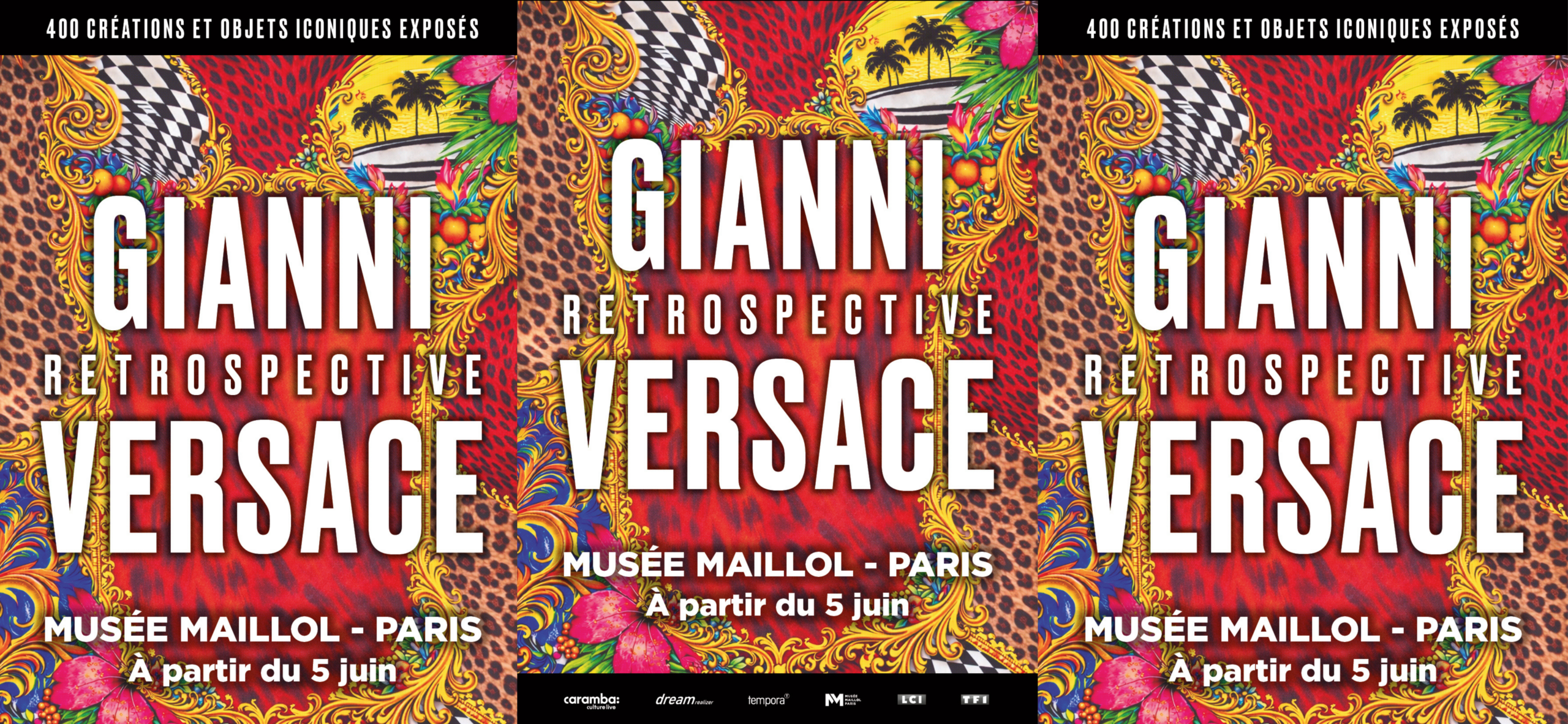
The retrospective presented at Paris’s Musée Maillol from 5 June to 31 October 2026 offers an opportunity to examine that career through original garments, sketches, accessories and archival material. Curated by Saskia Lubnow and Karl von der Ahé, the exhibition brings together the different influences that shaped his work, tracing the development of a designer whose creations were as closely connected to the arts as they were to the fashion industry.
Calabria, classical art and the origins of a signature
Born in Reggio Calabria in 1946, Versace grew up surrounded by clothing and dressmaking. His mother, Francesca, ran a dressmaking business, providing an early introduction to the practical realities of garment construction. This environment helped establish an understanding of fashion as something made, fitted and assembled, even as his later work became associated with theatrical presentation and visual extravagance.
Calabria also offered a cultural landscape in which the remains of Magna Graecia, religious imagery and Mediterranean ornament coexisted. Greek mythology and classical sculpture would become recurring elements of Versace’s aesthetic, most visibly through the Medusa emblem and the decorative vocabulary of his prints. These references were not simply historical embellishments. They allowed him to develop a visual identity that connected contemporary fashion with ancient ideals of beauty, power and physical presence.
The Musée Maillol exhibition traces these influences alongside Catholic iconography, Italian opera and Baroque art. Taken together, they reveal a designer who treated cultural references as material for reinterpretation rather than as fixed historical styles. A classical motif could become a graphic print, religious ornament could inform an evening garment and the elaborate compositions of Baroque art could be translated into a distinctly modern language of colour and surface.
Versace’s originality lay partly in the confidence with which he combined these sources. At a time when many designers sought coherence through a limited set of references, he embraced apparent contradictions, bringing classical imagery into contact with contemporary sexuality, traditional ornament with industrial materials and historical grandeur with the immediacy of popular culture.
Baroque and printed in silk
The printed silk shirt remains one of the most recognisable garments associated with Gianni Versace. Its decorative vocabulary, often involving chains, scrollwork, architectural elements and elaborate borders, transformed the shirt into a highly visible expression of identity. Rather than treating print as a secondary addition to a garment, Versace made it central to the design.
The Barocco motifs illustrate how carefully this apparent excess was constructed. Ornamental elements were arranged into graphic compositions that interacted with the cut of the garment, creating a relationship between surface and silhouette. Gold, black and saturated colours intensified the effect, producing clothing that could be recognised immediately, even outside the context of a runway.
This approach extended beyond shirts into dresses, tailoring, accessories and the wider visual identity of the house. Versace understood the power of repetition, returning to familiar motifs while changing their scale, placement and material expression. In doing so, he developed an aesthetic that was both highly decorative and remarkably consistent.
The exhibition’s presentation of textiles and garments offers a way to consider these prints as design rather than simply decoration. Their significance lies not only in their visual impact, but also in the relationship they establish between fabric, movement and the body. The same ornament that appears overwhelming in isolation can acquire a different rhythm once worn, especially when its placement follows the proportions of a garment.
Material innovation and the body
Versace’s reputation for extravagance sometimes obscures his interest in the technical possibilities of clothing. His work was not confined to elaborate prints and rich ornamentation. He also experimented with materials that allowed garments to behave differently on the body, using construction to create a particular relationship between sensuality and movement.
One of his most significant innovations was Oroton, a fine metal-mesh material associated with his designs from the early 1980s onwards. Its fluidity allowed metallic garments to drape and move with a softness that contrasted with their hard, reflective appearance. The result was a distinctive combination of armour-like shine and bodily flexibility, making metal appear almost as supple as fabric.
Oroton also exemplifies Versace’s ability to bring apparently incompatible qualities into a single garment. Its reflective surface suggested jewellery or protective metalwork, while its movement followed the contours of the wearer. Rather than concealing the body beneath structure, the material emphasised it through light, weight and motion.
The same interest in bodily expression informed his use of cut-outs, close-fitting silhouettes, slits and strategically placed fastenings. These elements were often described through the language of provocation, but their impact depended on precise decisions about proportion, support and exposure. Versace treated the body as an active component of the design, using clothing to frame and accentuate its presence rather than disguise it.
Fashion, music and the supermodel era
Versace’s influence cannot be separated from the cultural transformation of fashion during the late twentieth century. He recognised that clothing could acquire meaning beyond the runway through photography, performance and its association with prominent public figures. His relationship with musicians, actors and models helped establish a new visibility for the designer and his work.
The retrospective includes photographs and audiovisual material associated with figures such as Madonna, Elton John, Prince, Céline Dion and Diana, Princess of Wales. It also revisits the runway appearances of Linda Evangelista, Cindy Crawford and Claudia Schiffer, whose presence became inseparable from the mythology of 1990s fashion.
Versace was particularly adept at recognising the cultural power of the supermodel. His shows were not merely presentations of seasonal collections but events in which the personalities of the women wearing the clothes contributed to their reception. Models were celebrated as individuals, and their public identities became part of the broader image of the house.
This relationship between fashion and celebrity is now commonplace, yet Versace helped establish its modern vocabulary. He understood that a dress could become internationally recognisable through a single public appearance, just as a runway image could circulate beyond specialist fashion media and enter popular culture.
The black safety-pin dress worn by Elizabeth Hurley in 1994 remains a particularly clear example. Its construction combined a revealing silhouette with oversized gold fastenings, turning an element usually associated with utility into a defining visual feature. Its fame was not solely the result of celebrity exposure. The design itself possessed the graphic clarity necessary to remain recognisable decades later.
The importance of these moments extends beyond their place in fashion history. Versace demonstrated how the relationship between a designer, a garment and a public figure could create an image with a cultural life of its own. In contemporary fashion, where celebrity dressing and runway visibility are central to brand communication, that understanding feels especially familiar.
Stage costumes and artistic collaboration
Versace’s creative practice extended well beyond ready-to-wear and couture. His collaborations with choreographers and performers demonstrate an understanding of clothing as part of a larger artistic composition, particularly in environments where garments had to respond to movement, lighting and dramatic expression.
The exhibition revisits costumes designed for productions associated with Maurice Béjart, Roland Petit and William Forsythe, revealing another dimension of his work. Stage costume presents different demands from conventional fashion design. A garment must communicate visually across a distance while accommodating the physical requirements of performance, often exaggerating proportions or using materials that react strongly to movement and light.
For Versace, whose fashion already relied on a powerful relationship between the body and its surroundings, this was a natural extension of his practice. His work for the stage allowed him to explore clothing as a component of performance, while his runway presentations increasingly adopted some of the visual language associated with theatrical production.
The relationship was reciprocal. Fashion informed his costumes, but his engagement with dance and performance also reinforced the importance of movement, gesture and presentation in his collections. Seen in this context, his work becomes more than a sequence of commercially successful designs. It belongs to a broader creative practice in which clothing, photography, music and performance continually influenced one another.
Paris and the Atelier Versace years
Although Versace’s identity remained deeply connected to Italy, Paris played an important role in the international recognition of his work. His relationship with the city became particularly significant through his couture presentations, which offered an opportunity to explore more elaborate construction, exceptional materials and highly individualised designs.
His first haute couture collection was presented in Paris in 1989, followed by the opening of a boutique on Rue du Faubourg-Saint-Honoré in 1991. These developments positioned Versace within a fashion culture historically associated with French couture, even as he maintained the unmistakably Italian character of his work.
Atelier Versace offered a different scale of experimentation from ready-to-wear. Elaborate embroidery, complex surface treatments and precisely engineered silhouettes could be developed without the same commercial constraints, allowing the designer to explore the most technically ambitious aspects of his aesthetic.
The relationship between ornament and construction was particularly important. A richly embellished evening dress might appear to rely primarily on decorative impact, but its success depended equally on the engineering beneath the surface. The placement of seams, the control of weight and the balance between structure and movement determined how the garment behaved once worn.
Paris also occupies a poignant place in Versace’s final chapter. On 6 July 1997, he presented what would become his last couture collection. Nine days later, on 15 July, he was murdered outside his Miami Beach home at the age of fifty. The proximity of those events has inevitably shaped the way his final work is remembered, although the collection deserves to be understood as part of an ongoing creative evolution rather than solely through the circumstances of his death.
Pieces of a lifetime
The Musée Maillol presentation occupies the museum’s ground and first floors, with scenography designed by Nathalie Crinière. The organisers describe a deliberately pop-inspired environment intended to reflect the energy of Versace’s visual universe. The exhibition brings together fashion, decorative objects and archival media, creating connections between the garments and the wider cultural context in which they were conceived.
The scale is substantial, although the published descriptions use different methods of counting the objects on display. The museum refers to approximately 450 pieces, while the City of Paris describes 120 silhouettes and around 600 objects and archival materials. Rather than suggesting a single definitive count, these figures indicate a broad presentation encompassing garments, supporting documentation and other objects.
The curators have emphasised the importance of original artefacts in their approach. Their broader retrospective project draws on collectors and archival networks, focusing on work created during Versace’s lifetime rather than the subsequent development of the fashion house. This distinction is particularly valuable for a designer whose visual codes have continued to circulate long after his death, sometimes becoming more familiar than the historical collections from which they originated.
There is, however, a curatorial challenge inherent in presenting a designer so strongly associated with visual abundance. Versace’s garments can command attention individually, and a densely populated exhibition risks reinforcing the impression that his significance lies principally in ornament and extravagance. The more revealing approach is to examine how those qualities were achieved and why they mattered within the fashion culture of his time.
The presence of sketches, photographs and audiovisual material can help establish that context, connecting finished garments to their sources of inspiration and public reception. A dress becomes more informative when considered alongside the artistic references, technical choices and images that contributed to its identity. The retrospective’s value therefore lies not simply in assembling recognisable pieces, but in making the creative relationships between them more apparent.
Gianni Versace’s place in fashion history
Almost thirty years after his death, Versace’s influence remains visible in the relationship between luxury fashion and popular culture. His work anticipated many of the mechanisms through which contemporary fashion now communicates, from celebrity dressing and instantly recognisable brand imagery to runway presentations conceived for an audience far larger than those physically present.
His aesthetic also offers an interesting counterpoint to the recurring dominance of minimalism. Versace did not regard ornament as something that needed justification through understatement. Colour, embellishment and sensuality were fundamental parts of his design language, supported by an understanding of construction and material behaviour that made even his most elaborate creations wearable.
Yet his significance should not be measured only through the visual codes that have survived. His ability to move between classical art, industrial experimentation, couture, dance and celebrity culture helped establish a broader understanding of what a fashion designer could do. He recognised that fashion could participate in cultural life without surrendering the specificity of clothing as a craft.
The retrospective at Musée Maillol provides an occasion to reconsider that achievement through the work itself. Its historical value is particularly apparent in the distinction between Gianni Versace’s personal creative output and the larger brand identity that continued after 1997. By returning attention to original garments and the circumstances of their creation, the exhibition invites a more precise understanding of a designer whose public image has sometimes overshadowed the complexity of his practice.
Versace’s work was exuberant, certainly, but exuberance alone does not explain its endurance. Beneath the gold, the prints and the celebrity mythology was a coherent design philosophy, one that treated the body as a source of expression, historical art as a living resource and fashion as an essential part of contemporary culture. Nearly three decades later, those ideas remain central to understanding his contribution to fashion.
May