
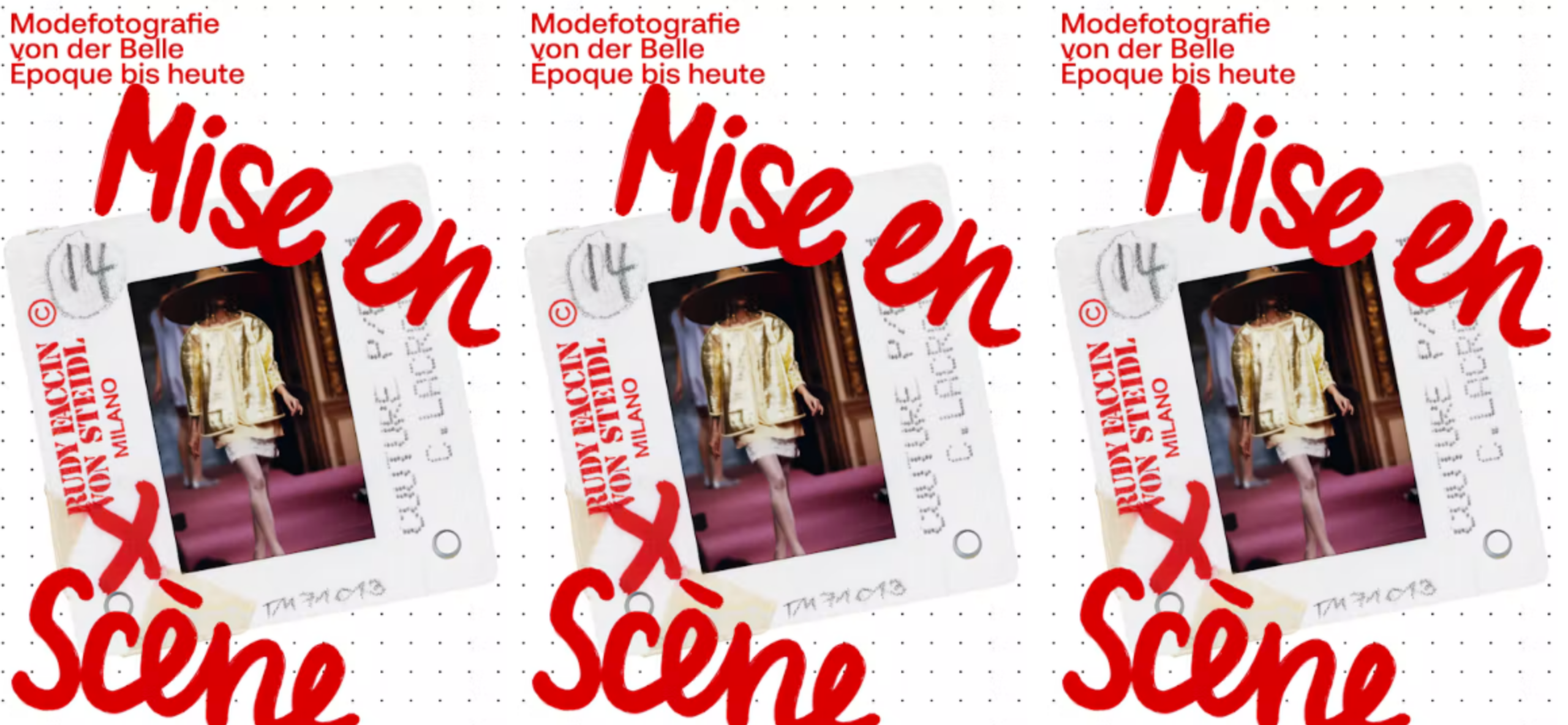

From the carefully composed portraits of the Belle Époque to the provocative imagery of the late twentieth century, fashion photography has shaped far more than the way clothing is presented. At the Textile Museum St. Gallen, Mise en Scène explores over 120 years of images, revealing the relationship between photography, changing ideals of beauty and the Swiss textile industry.
A photograph can make a garment famous long after it has disappeared from the runway. Its silhouette, the way it falls on the body, the expression of the person wearing it and even the setting chosen by the photographer can become inseparable from how a collection is remembered. Fashion photography has always involved this process of interpretation, turning clothing into images that communicate the tastes, aspirations and social conventions of a particular moment.
Yet these images are rarely neutral records. The photographer determines how the body is presented, which details deserve attention and what kind of woman or man the clothes appear to represent. A fashion photograph can reinforce an established ideal or challenge it, sometimes doing both within the same composition. Across the twentieth century, changes in photographic style accompanied shifts in social expectations, from the formal elegance of the early 1900s to the more experimental representations of identity that followed.
Mise en Scène. Fashion Photography from the Belle Époque to the Present Day, presented at the Textile Museum St. Gallen from 3 July 2026 to 28 February 2027, examines this history through works by photographers including the Séeberger brothers, Atelier d’Ora Benda, Tom Kublin, Helmut Newton, Peter Knapp and Jeanloup Sieff. Drawing on the museum’s photographic holdings and other Swiss collections, the exhibition places international fashion imagery alongside fabrics, garments and archival material from the country’s textile industry.
Its particular interest lies in that relationship. Rather than presenting fashion photography exclusively as a history of celebrated photographers and memorable editorial images, the exhibition considers the textiles and industries that helped make those images possible.
Society portraits
Fashion photography emerged from a visual culture in which portraiture, social status and clothing were closely connected. During the Belle Époque, elaborate dresses, decorated hats and carefully arranged accessories communicated a woman’s position in society as much as her personal taste. Photography provided a means of recording these appearances, initially borrowing much of its formality from established conventions of studio portraiture.
The exhibition’s early material includes work associated with Nathan Lazarnick, whose photographs reveal how closely fashion imagery and society portraiture overlapped. Clothing was presented within a broader representation of the sitter, and the distinction between documenting a fashionable individual and producing a fashion image was not always clear.
The garments themselves reflected the extraordinary craftsmanship of the period. Embroidery, lace and decorative fabrics were central to fashionable dress, particularly among wealthy European and American clients. Eastern Switzerland had already established an international reputation for its textile production, supplying materials that travelled far beyond the region in which they were manufactured.
This connection complicates the familiar geography of fashion history. Paris may have dominated the development of couture, while cities such as New York helped establish the commercial and editorial language of modern fashion photography, but the garments appearing in those images often depended on specialised production networks elsewhere. St. Gallen’s embroidery industry formed part of that international exchange, contributing to the material culture that photographers recorded.
Photography therefore preserved more than an evolving sequence of fashionable silhouettes. It also documented the circulation of craftsmanship, the economic importance of textile production and the social environments in which certain forms of dress acquired their meaning.
Dressing for the races
By the 1920s, fashion photography was recording a visibly different relationship between clothing and the female body. Hemlines rose, silhouettes became straighter and garments increasingly accommodated movement. The heavily structured forms associated with the previous generation gave way to a new vocabulary of modern dress, shaped by changing lifestyles and the cultural transformations that followed the First World War.
The exhibition includes photographs taken at the Longchamp racecourse in Paris, a setting that had become an important place for observing and recording fashionable society. The racetrack offered photographers something different from the controlled environment of a studio. Clothing appeared in public, worn by women participating in a social occasion rather than posing exclusively for a commercial image.
These photographs occupy an interesting position between fashion reporting and social documentation. They show the styles that circulated among fashionable women while also revealing the circumstances in which those styles were displayed. Hats, coats, dresses and accessories become part of a wider scene, surrounded by the architecture and social rituals of the racecourse.
The changes in silhouette were significant, although they should not be mistaken for a universal transformation in women’s lives. Fashion photography tended to represent those with access to fashionable clothing and the leisure activities in which it could be worn. Nevertheless, the images offer evidence of changing expectations surrounding femininity, mobility and public appearance.
The growing importance of illustrated magazines also altered the circulation of fashion imagery. Photographs could reach audiences far removed from the social environments in which they were made, allowing readers to encounter new silhouettes, gestures and ways of dressing through printed images. Fashion became increasingly visible as a shared cultural language, even when the garments themselves remained inaccessible to many.
Bodies, movement and modern femininity
The 1930s brought further changes in the representation of women, particularly through photography concerned with sportswear, swimwear and lingerie. As garments revealed more of the body, photographers developed new approaches to posture, lighting and composition. The relationship between clothing and physical form became increasingly direct.
Among the exhibition’s examples are photographs produced by the Viennese Atelier d’Ora Benda for the Swiss underwear company Hanro. These images reflect the growing commercial importance of modern lingerie and swimwear, as well as the changing ideals of femininity associated with physical activity and bodily confidence.
The photographs also demonstrate how fashion imagery could help establish new conventions of looking. A body photographed in sportswear or lingerie was not simply displaying a product. Its pose, expression and surroundings contributed to a particular idea of modern womanhood, often associating fashionable appearance with youth, health and freedom of movement.
Such representations were never entirely detached from commercial interests. Photography could celebrate changing attitudes towards the body while simultaneously establishing new standards of appearance. The apparent liberation of the silhouette did not necessarily mean freedom from aesthetic expectations, a contradiction that would remain central to fashion imagery throughout the following decades.
The historical value of these photographs lies partly in this ambiguity. They reveal the changing relationship between women and clothing, but they also show how advertising and fashion media participated in defining the appearance of the modern female body.
Couture and post-war femininity
Following the Second World War, fashion photography entered another period of transformation. Christian Dior’s New Look, introduced in 1947, helped restore a highly structured ideal of elegance, characterised by defined waists, full skirts and a renewed emphasis on couture craftsmanship. Photography played an essential role in communicating these silhouettes, presenting them as expressions of post-war luxury and femininity.
The exhibition includes photographs by Tom Kublin, whose work is particularly relevant to the relationship between international couture and Swiss textile manufacturing. Images produced for Forster Willi in 1959 and 1960 demonstrate how embroidered fabrics could be presented through the language of high fashion, connecting specialised textile production with the glamour of the finished garment.
Kublin’s photographs are significant because they operate on several levels. They promote the visual appeal of fashion while documenting the materials and technical expertise behind it. Embroidery becomes part of the photograph’s composition, interacting with the silhouette, the model’s pose and the photographer’s treatment of light.
In this context, photography served both the couture industry and the textile manufacturers supplying it. A successful image could communicate the refinement of a finished dress while demonstrating the possibilities of a particular fabric. The relationship between these industries was mutually beneficial, even if the names of designers and photographers generally became more familiar to the public than those of the manufacturers.
Post-war fashion photography also contributed to the construction of a particular feminine ideal. Elegance was frequently associated with controlled posture, carefully arranged clothing and an image of polished sophistication. These photographs reveal the aesthetic priorities of their period, but they also provide a record of the social expectations that accompanied them.
Experimentation, sexuality and image-making
The second half of the twentieth century brought a more experimental approach to fashion imagery. Photographers increasingly challenged the conventions of studio portraiture, using unusual compositions, dramatic lighting and less formal poses. Fashion photographs could suggest narratives, introduce ambiguity or deliberately disturb expectations surrounding beauty and elegance.
Helmut Newton’s work became particularly influential in this development. His photographs frequently explored the relationship between fashion, sexuality and power, presenting women in images that could appear assertive, theatrical or unsettling. The exhibition includes fashion photographs he produced for Swiss textile companies Forster Willi and Jakob Schlaepfer in 1972, offering a direct connection between his distinctive photographic language and the commercial presentation of fabrics.
Newton’s work illustrates the extent to which the photographer could influence the meaning of a garment. Clothing remained central to the image, but its presentation depended increasingly on atmosphere, character and the relationships suggested within the composition. The resulting photograph could communicate ideas that extended well beyond the garment’s material qualities.
Peter Knapp approached fashion imagery from another direction, bringing graphic experimentation and a strong sense of visual rhythm to his editorial work. His photography contributed to the modernisation of fashion magazines during the 1960s, when art direction and photographic composition became increasingly adventurous.
Jeanloup Sieff, meanwhile, developed a recognisable black-and-white aesthetic characterised by tonal contrast, distinctive perspectives and a close attention to the human figure. His work demonstrated how fashion photography could establish an atmosphere through relatively limited visual means, relying on the interaction between the model, the garment and the photographic frame.
The exhibition’s inclusion of Sieff’s advertising photographs for Leganza, produced for Media AG Heiden in 1988, again connects an internationally recognised photographer with a Swiss company. These collaborations show that regional textile businesses were not simply supplying materials to the fashion industry. They were also commissioning and participating in the creation of sophisticated visual identities.
Taken together, these photographers demonstrate the increasing independence of fashion photography as a creative discipline. Commercial purpose remained important, but it no longer determined a single visual approach. Fashion images could be elegant, provocative, humorous or deliberately unconventional, reflecting a growing recognition of photography as a medium with its own artistic possibilities.
Fashion’s Swiss connections
One of the exhibition’s most distinctive contributions is its attention to an industry that usually remains outside the frame. While fashion photography has traditionally been discussed through the reputations of designers, models and photographers, the fabrics themselves have a history that is often less visible.
Eastern Switzerland’s textile industry has long maintained relationships with international fashion houses, producing embroidery, lace and specialised fabrics used in couture and ready-to-wear. Companies such as Forster Rohner and Jakob Schlaepfer contributed to collections that circulated through the fashion capitals, while their materials appeared in photographs commissioned for magazines, advertising and commercial catalogues.
Mise en Scène makes these connections tangible by displaying textiles, garments, sample books and company archives alongside the photographic works. The museum’s own collection contains approximately 20,000 photographic objects, including glass negatives, prints, slides and digital material. The exhibition draws attention to this significant, relatively little-studied part of its holdings, supplemented by other public and private Swiss collections.
An especially revealing example is Peter Knapp’s 1969 photograph of models wearing Ungaro suits made with fabric from Jakob Schlaepfer. The image belongs to the visual culture of the late 1960s, with its experimental approach to colour, fashion and youthful identity. Yet it also records the contribution of a Swiss textile producer to a garment associated with Parisian fashion.
Such examples encourage a more complete reading of fashion photographs. The photographer creates the composition, the designer develops the silhouette and the model brings the garment into the image, but the textile manufacturer has already contributed essential decisions about texture, surface and material possibilities. Those contributions can be difficult to identify once the image begins circulating independently of its original commercial context.
By restoring that information, the exhibition makes fashion photography useful as a historical source without diminishing its artistic qualities. It reveals how photographic images connected the ambitions of designers with the expertise of manufacturers, and how regional industries participated in an international culture of fashion.
Contemporary perspectives
The exhibition extends into the present through photographers including Steven Klein, Anton Corbijn and Iwan Baan, whose work reflects the increasingly fluid boundaries between fashion photography and other visual disciplines. Their inclusion moves the exhibition beyond a conventional chronology of editorial styles, suggesting how fashion imagery has become part of a much wider visual culture.
Contemporary fashion photography operates across magazines, campaigns, digital platforms, moving images and artistic projects. Its relationship with clothing has consequently become more varied. A fashion photograph might communicate the details of a collection, establish the atmosphere of a brand or construct a visual narrative in which the garments occupy only part of the composition.
These developments also complicate the distinction between commercial and artistic photography. Fashion images are frequently produced for specific clients, yet their visual ambitions may extend beyond immediate promotional needs. The same image can function as advertising, portraiture, cultural commentary and a work of photographic art, depending on its context and subsequent circulation.
The inclusion of Iwan Baan, particularly known for architectural photography, is indicative of this expanded understanding. Fashion is increasingly represented through relationships with architecture, landscape and spatial experience, while the conventions of editorial photography continue to influence other creative fields.
Digital circulation has introduced further changes. Images now reach audiences almost immediately and are encountered in contexts that photographers and editors cannot fully control. Cropping, reposting and algorithmic distribution can alter how a fashion photograph is seen, while the speed of contemporary media encourages a continuous production of new visual material.
Although these developments differ considerably from the illustrated magazines of the early twentieth century, the underlying relationship remains recognisable. Fashion photography still mediates between clothing and its audience, shaping the meaning of garments through the choices made behind the camera.
Shifting perceptions of beauty
Across the exhibition’s historical material, the representation of women emerges as a particularly significant theme. Fashion photography has repeatedly participated in defining desirable appearances, from the composed social figures of the Belle Époque to the athletic bodies of the interwar years, the polished femininity of the post-war period and the increasingly varied representations that followed.
These images can reveal social change, but they also demonstrate the influence of fashion media in establishing standards of beauty. The photograph selects a body, a pose and an expression, presenting them within an aesthetic framework that can make particular characteristics appear desirable or authoritative.
The distinction between representing changing social attitudes and actively shaping them is not always clear. A photograph may reflect the fashions of its time while encouraging viewers to adopt the appearance and behaviour it presents. This relationship is especially relevant to the representation of femininity, which has frequently been constructed through the combined interests of fashion houses, photographers, advertisers and magazine editors.
The exhibition’s historical scope makes it possible to consider these conventions as changing cultural constructions rather than permanent ideals. What appeared elegant or modern in one period could become outdated in another, while qualities previously excluded from fashionable imagery gradually entered its visual vocabulary.
Contemporary discussions surrounding representation, body diversity and the influence of social media give this history particular relevance. Although the technologies of image production and circulation have changed, questions about who controls representation, whose bodies are considered fashionable and how beauty is communicated remain closely connected to the earlier history of the medium.
Mise en Scène does not need to resolve these questions to make them worth examining. Its contribution lies in providing a historical framework through which the apparent naturalness of fashion imagery can be reconsidered. The photographs may depict clothes, but they also preserve the expectations and assumptions of the societies that produced them.
Faces behind the industry
A related exhibition at the Textile Museum offers a striking contrast to the constructed world of fashion imagery. Presented in the museum’s lounge, Portrait of a Swiss Company features a photographic series created by Barbara Davatz in 1972, documenting employees of the textile company Walser AG in Herisau.
Rather than photographing models wearing finished garments, Davatz turned her camera towards the people working within the textile industry. The series records 38 employees, accompanied by information including their names, nationalities and occupations. Its straightforward approach differs considerably from the elaborate visual conventions associated with fashion photography.
The juxtaposition is particularly interesting because the two exhibitions concern different stages of the same industry. Fashion photography often transforms materials into images of aspiration, while Davatz’s portraits draw attention to the people whose labour contributes to textile production.
The photographs also belong to different traditions of image-making. Davatz’s work is concerned with individual presence and social documentation rather than the presentation of fashionable appearance. Yet both forms of photography depend on decisions about framing, context and the relationship between the subject and the viewer.
Seen together, the exhibitions offer a broader understanding of fashion’s visual history, encompassing both the carefully staged image and the industrial realities that remain largely absent from it.
A century of fashion imagery
The significance of Mise en Scène lies in its treatment of fashion photography as something more complex than a succession of beautiful images. Its historical range makes changes in clothing and photographic technique visible, while its connection to the Swiss textile industry reveals the commercial and material networks behind many of those photographs.
The exhibition also arrives at an important moment for the Textile Museum St. Gallen. It is the institution’s final major temporary exhibition before an extensive renovation, with the museum scheduled to close from March 2027. The presentation therefore offers an opportunity to explore a substantial part of its photographic holdings before the building enters a new phase.
Perhaps the most interesting aspect of this history is the way a photograph can outlive the immediate purpose for which it was made. Images originally commissioned to advertise textiles or present a collection can later become evidence of changing social conventions, artistic experimentation and industrial relationships. Their commercial origins do not prevent them from acquiring historical or cultural significance.
A fashion photograph preserves a particular arrangement of clothing, body and image, but its meaning continues to change as the period that produced it becomes more distant. By bringing these photographs into dialogue with the materials and industries behind them, Mise en Scène encourages viewers to consider not only what fashion looked like, but how its images were created and what they have taught successive generations to see.
May