
Most runway shows end the moment the final look disappears backstage.
The applause fades, guests leave their seats and, within minutes, the collection begins a new life online through thousands of carefully selected images. What remains is often a sequence of photographs that capture the silhouettes but inevitably compress the experience of seeing them in motion.
At the Musée Rodin, Dior proposed a different pace.
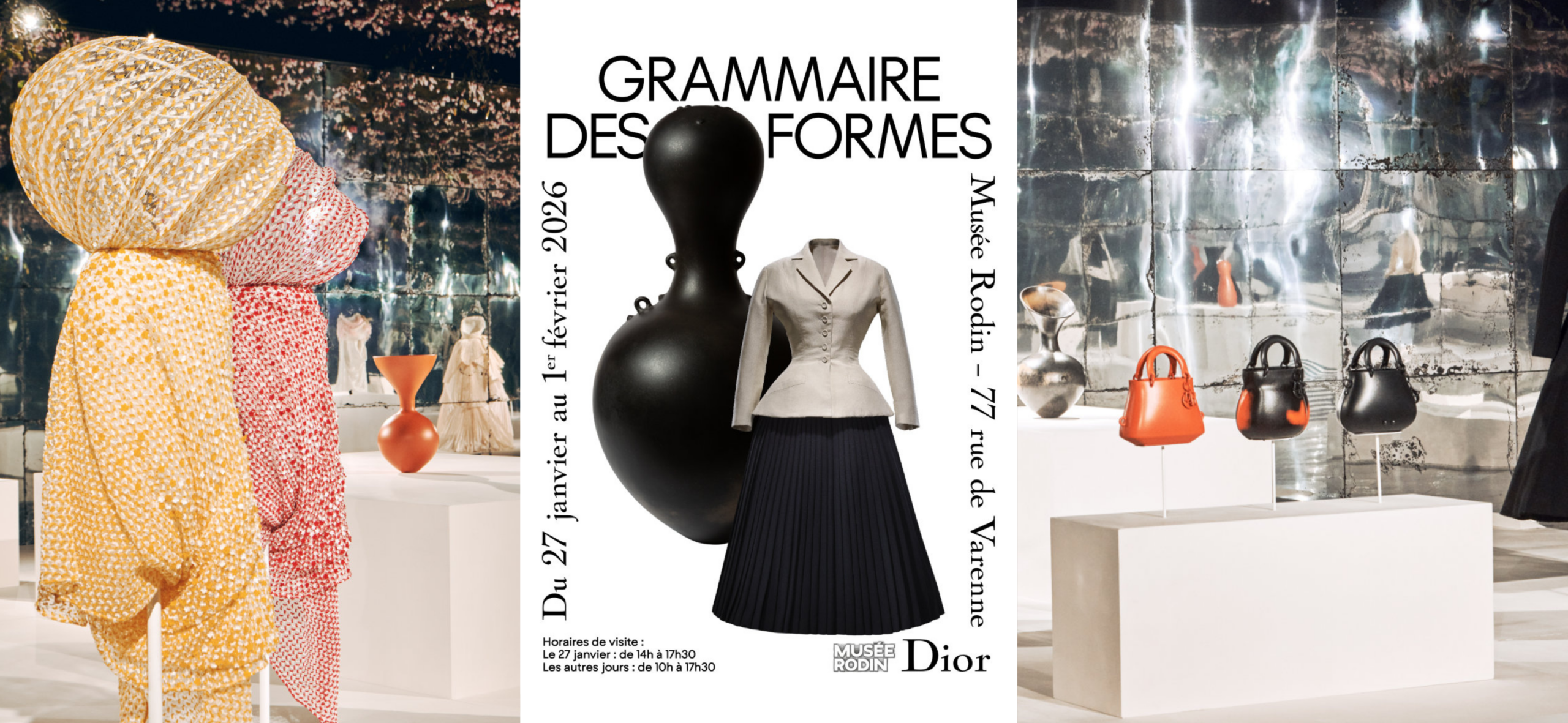
Presented during Paris Haute Couture Week Fall/Winter 2026 to 2027, Grammar of Forms extended Jonathan Anderson’s second haute couture collection beyond the runway, not as a retrospective or a promotional display, but as another way of experiencing the ideas behind it. Rather than asking visitors to remember what they had seen, the exhibition invited them to spend time with the collection, allowing couture to unfold through space, material and dialogue.
Installed throughout the museum, the project explored the visual language behind the collection instead of presenting garments as isolated objects. Volumes echoed one another across the galleries, sculptural gestures appeared in both fashion and contemporary art, while shifting light transformed surfaces over the course of the day. The result encouraged observation rather than explanation, asking visitors to discover relationships between objects instead of following a fixed narrative.
Unlike many fashion exhibitions organised around chronology or heritage, Grammar of Forms was conceived as a physical experience. Texture, proportion, movement and scale became its vocabulary, allowing the collection to be understood through the body as much as through the eye.
Experiencing couture differently
That shift fundamentally changed the relationship between the audience and the clothes.
On the runway, every look exists for only a few seconds before giving way to the next. Inside the museum, visitors set their own rhythm. They could approach a garment from multiple angles, return to it later or pause over details that would normally disappear in the pace of a show.
Pleats responded differently as the light moved through the galleries. Structured silhouettes cast unexpected shadows, while embroidered surfaces revealed levels of craftsmanship that photographs rarely capture. The installation demonstrated that couture rewards prolonged attention, even though the runway rarely allows for it.
It also reflected Jonathan Anderson’s long standing interest in the way objects occupy space. Throughout the exhibition, garments were presented not simply as clothes to be worn, but as forms capable of shaping their surroundings. Their presence extended beyond the body, creating conversations with architecture, light and the works placed around them.
In that context, craftsmanship became more than evidence of technical skill. It became one of the installation’s central subjects. Every seam, every fold and every embroidered surface reflected countless decisions made inside the atelier, bringing into view the process behind garments that are often experienced only as finished objects.
Lynda Benglis and a shared language of form
Also central to the exhibition was the work of American artist Lynda Benglis, whose practice has challenged conventional ideas of sculpture for more than five decades.
Known for fluid forms, poured materials and experimental surfaces, Benglis has consistently explored movement, gravity and transformation. Those same concerns resonate throughout Anderson’s work, where garments often blur the boundary between fashion and sculpture.
Rather than illustrating the collection, Benglis’s works entered into conversation with it. Organic forms found echoes in folded fabrics, while glossy, molten surfaces reflected the sculptural qualities of the couture silhouettes. The dialogue was less about tracing direct influences than revealing a shared curiosity for material, form and the way objects occupy space.
Architecture completed that conversation. The historic interiors of the Musée Rodin offered a beautiful contrast with the contemporary language of Anderson’s couture, reinforcing the dialogue between heritage and experimentation that continues to shape Dior’s recent work.
Fashion, art and architecture ultimately shared the same visual language without either discipline seeking to dominate the others.
When museums become part of the collection
Runway presentations communicate through immediacy. Museum installations encourage a slower form of observation. Together, they create complementary ways of understanding the same collection.
Dior is far from alone in exploring that approach. Across Paris, exhibitions, archival presentations and artistic collaborations increasingly accompany Haute Couture Week, reflecting a broader shift in how luxury houses choose to communicate their identity. Rather than relying on a single runway show, many now extend their collections into museums, galleries and cultural institutions.
This evolution also mirrors changing expectations from audiences. Fashion enthusiasts increasingly seek context alongside the finished garment. They want to understand the references, craftsmanship and creative process that shape a collection, not simply admire its final result. Exhibitions such as Grammar of Forms respond to that curiosity by creating space for closer observation rather than faster consumption.
Perhaps the installation’s greatest achievement is that it refuses to present fashion as an isolated discipline. Clothing, sculpture, architecture and material research intersect throughout the exhibition until couture becomes another artistic medium, capable of expressing movement, emotion and abstract ideas with the same depth as painting or sculpture. It is an ambition that feels particularly significant at a moment when luxury houses increasingly position themselves as cultural institutions.
The future of the fashion exhibition
The runway remains essential, but it is no longer the only place where a collection exists. Museums have become spaces where fashion can breathe differently, inviting visitors to slow down, observe and return to the work on their own terms.
Over the past two decades, fashion exhibitions have evolved beyond celebrating archives or displaying iconic garments behind glass. Increasingly, they participate in the creative act itself, expanding a collection rather than simply documenting it. Grammar of Forms illustrates that transformation with remarkable clarity.
Rather than looking backwards, the installation exists alongside the collection, extending its ideas instead of explaining them. It suggests that the future of couture may lie not only in exceptional garments, but in the environments created around them.
As visitors leave the Musée Rodin, they carry with them more than memories of beautiful clothes. They leave having experienced the collection from within. Perhaps that is the exhibition’s most enduring idea. Couture is no longer experienced only as something to watch. It has become a space to inhabit.
May