
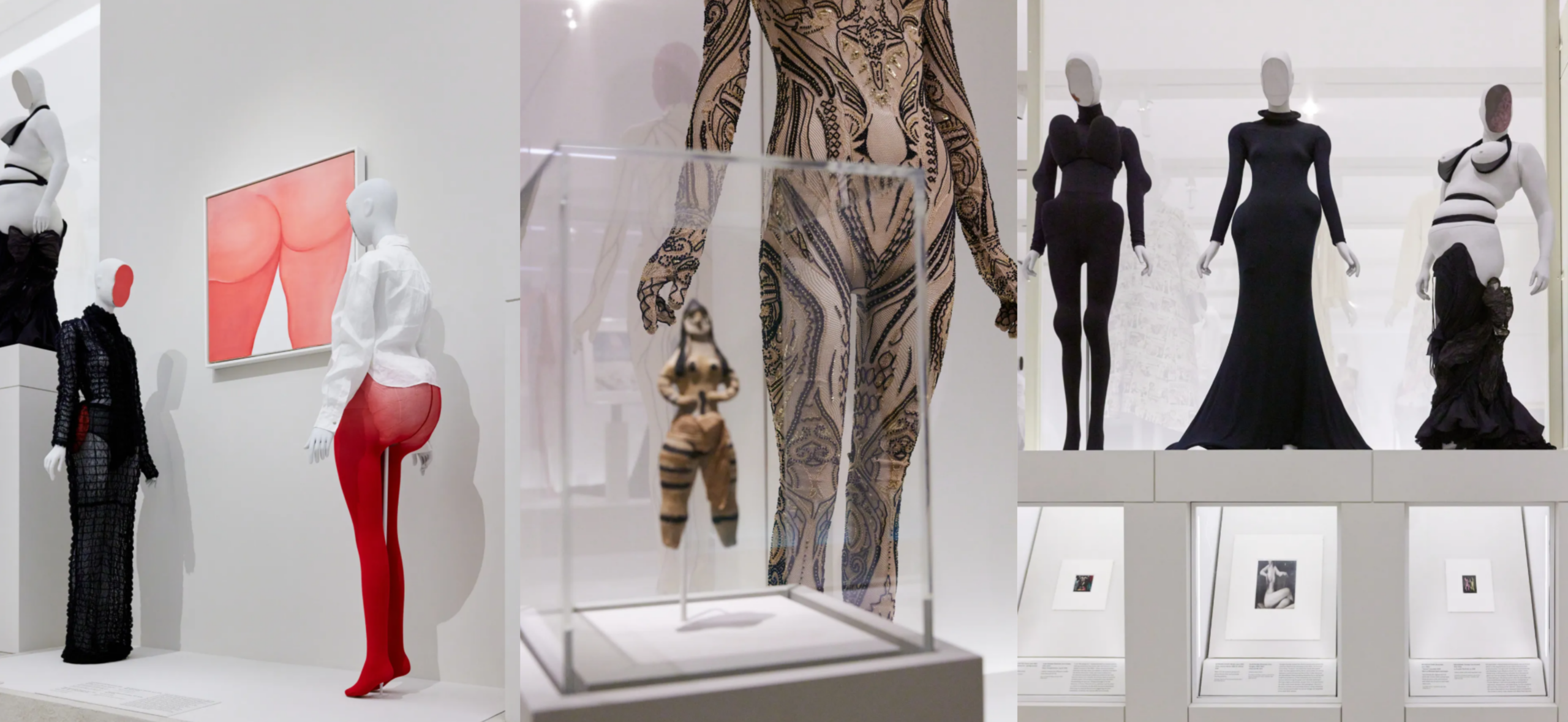

Fashion has spent a long time negotiating its place inside the museum. Costume Art, which opened at the Metropolitan Museum of Art on May 10, 2026, begins from a different position. Rather than asking whether clothing deserves to stand beside painting or sculpture, the exhibition turns the question around. Look closely at art history, it suggests, and the dressed body has been there all along.
That argument carries particular weight because of where it is being made. Costume Art inaugurates the Condé M. Nast Galleries, the Costume Institute’s new nearly 12,000-square-foot exhibition space adjacent to the Great Hall. For an institute whose spring exhibitions previously had no permanent dedicated galleries, the move gives fashion a far more visible architectural presence within the museum.
But the significance of the exhibition lies in more than square footage. Curated by Andrew Bolton, Costume Art brings garments from the Costume Institute into direct conversation with objects held across the Met’s wider collection. Nearly 400 works move between fashion, painting, sculpture, photography and decorative arts, primarily within the history of Western art from prehistory to the present. Clothing is not treated as an illustrative addition to those disciplines. It becomes part of the same visual argument.
The body as common ground
At the centre of Costume Art is something more fundamental than fashion itself. It is the body, clothed, exposed, idealised, altered, ageing and sometimes absent.
The exhibition is organised through different conceptions of the human form, allowing garments and artworks separated by centuries to meet through shared ideas rather than chronology. A Georgina Godley pregnancy dress appears in dialogue with a bronze by Edgar Degas. Alexander McQueen’s carved prosthetic boots, created for Paralympian Aimee Mullins in 1999, enter a section devoted to disability. Elsewhere, historical representations of idealised bodies encounter contemporary designers who deliberately distort, expose or reconsider them.
These juxtapositions make the exhibition’s argument unusually clear. Fashion does not simply cover the body. It participates in the way bodies are understood.
That distinction matters. Ideas surrounding beauty, gender, age, disability, sexuality and physical difference have always been carried through dress, just as they have through painting and sculpture. Clothing can reinforce an ideal body or resist it. It can conceal, exaggerate, protect and transform. By placing garments beside artworks rather than isolating them within a history of dress, Costume Art makes those relationships difficult to overlook.
Fashion moves upstairs
There is a quiet symbolism in the Costume Institute moving into galleries beside the Great Hall. For years its spring exhibition occupied temporary space, while much of its collection remained physically removed from the museum’s most prominent galleries. The new location changes that relationship.
This does not mean fashion has suddenly arrived at the Met. The Costume Institute became part of the museum in 1946, and its exhibitions have grown into some of the institution’s most visible cultural events. What has changed is the permanence of its presence.
The new galleries, designed by Peterson Rich Office, give the department a dedicated home for its annual spring exhibition and can periodically accommodate projects from other curatorial departments exploring intersections between fashion and art. Their position within the museum makes an institutional statement that would be difficult to communicate through an exhibition alone.
It also arrives after the old argument over whether fashion qualifies as art has begun to feel increasingly inadequate. Fashion does not need to become painting in order to deserve serious study, nor does every garment require the status of an artwork. Its importance lies partly in its ability to reveal something different. Clothes exist unusually close to lived experience. They touch bodies, respond to social expectations and carry traces of identity in ways that few other creative disciplines can.
The more interesting question is therefore not whether fashion is art, but what becomes visible when museums stop treating the two as separate histories.
Clothes become arguments
Museum display inevitably changes a garment. Removed from the runway, shop or wardrobe, clothing loses some of its original immediacy. It no longer belongs quite so firmly to a season or commercial cycle.
In return, other qualities become easier to read. Construction can be studied at close range. Material decisions acquire greater weight. References that disappeared within the speed of a collection can emerge again years later, sometimes revealing connections that were barely visible when the garment was new.
Costume Art makes particularly effective use of that distance. Its pairings do not depend solely on direct artistic inspiration. Some are visual, others conceptual, political or symbolic. A garment can echo the contour of a sculpture without having been inspired by it. Two objects made centuries apart can reveal remarkably persistent ideas about which bodies a culture chooses to celebrate and which it prefers not to see.
The museum therefore does something fashion itself rarely has time to do. It interrupts the cycle.
A collection normally arrives with the next one already approaching. Images circulate within minutes and interpretation follows almost as quickly. Inside the museum, the garment can wait. The viewer can return to a seam, an embroidery or an uncomfortable comparison without another season immediately replacing it.
There is something almost contradictory about preserving fashion this way. A discipline built around change acquires another life precisely by being removed from its original moment.
Who appears in fashion history
The exhibition becomes more complicated, and more valuable, when it turns towards bodies that have historically occupied less space within both fashion imagery and museum collections.
Sections devoted to pregnancy, larger bodies, disability and ageing challenge the idealised figure that has dominated much of Western visual culture. The approach is not without difficulties. Even the language used to classify bodies carries historical and contemporary tensions, and W Magazine questioned the exhibition’s decision to use the term « Corpulent Body » despite reported feedback from activists.
That discomfort should not necessarily be smoothed away. Museums do not simply preserve neutral versions of history. They organise objects, create categories and decide which relationships deserve attention. Every exhibition constructs an argument, and every collection contains absences.
Fashion museums face the same problem on another scale. Institutional recognition can help preserve designers, techniques and communities that might otherwise disappear from the historical record, but recognition is selective by nature. Once a garment enters a major collection, it gains a form of permanence that thousands of others will never receive.
For institutions expanding their engagement with fashion, the challenge is therefore larger than proving its cultural importance. It is deciding whose fashion becomes culture worth preserving.
Looking slowly
There is another reason exhibitions such as Costume Art feel particularly relevant now. Much of contemporary fashion is encountered first through a screen.
A runway can be watched from another continent while it is happening. A collection is fragmented into individual looks, reposted, enlarged and converted into references before many viewers have seen the garments move. Fashion has perhaps never been more accessible visually, yet the object itself can feel increasingly distant.
A museum offers almost the opposite experience.
Scale returns. So does texture. A garment occupies physical space beside the viewer and its relationship to the body becomes harder to flatten into an image. Details that disappear on a phone begin to matter again, while the proximity of objects made centuries apart slows down the instinct to read everything as new or obsolete.
This slower rhythm does not make the museum inherently more meaningful than the runway or the screen. Each produces a different understanding of fashion. But exhibitions can provide something increasingly rare within the industry’s accelerated image cycle, the possibility of staying with an object long enough for the first impression to change.
A permanent place for an impermanent medium
Perhaps the most important aspect of Costume Art is ultimately not its attempt to settle the relationship between fashion and art. The exhibition is stronger when it leaves that boundary slightly unresolved.
Fashion has its own relationship with time, commerce, identity and the body. Treating it seriously does not require removing those contradictions or translating clothing into the language of another discipline. If anything, they are precisely what make it culturally revealing.
The opening of the Condé M. Nast Galleries gives that argument a physical form. Fashion now occupies a permanent architectural place near the centre of one of the world’s major museums, while Costume Art uses its inaugural exhibition to show that clothing has been present throughout the histories held inside it.
There is an appealing reversal in that idea. Fashion has often looked towards art for legitimacy, borrowing its references and entering its institutions one exhibition at a time. At the Met, the perspective shifts. Walk through thousands of years of bodies, portraits, sculptures and objects, and fashion is already there.
Not at the edge of the story, but woven through it.
May