
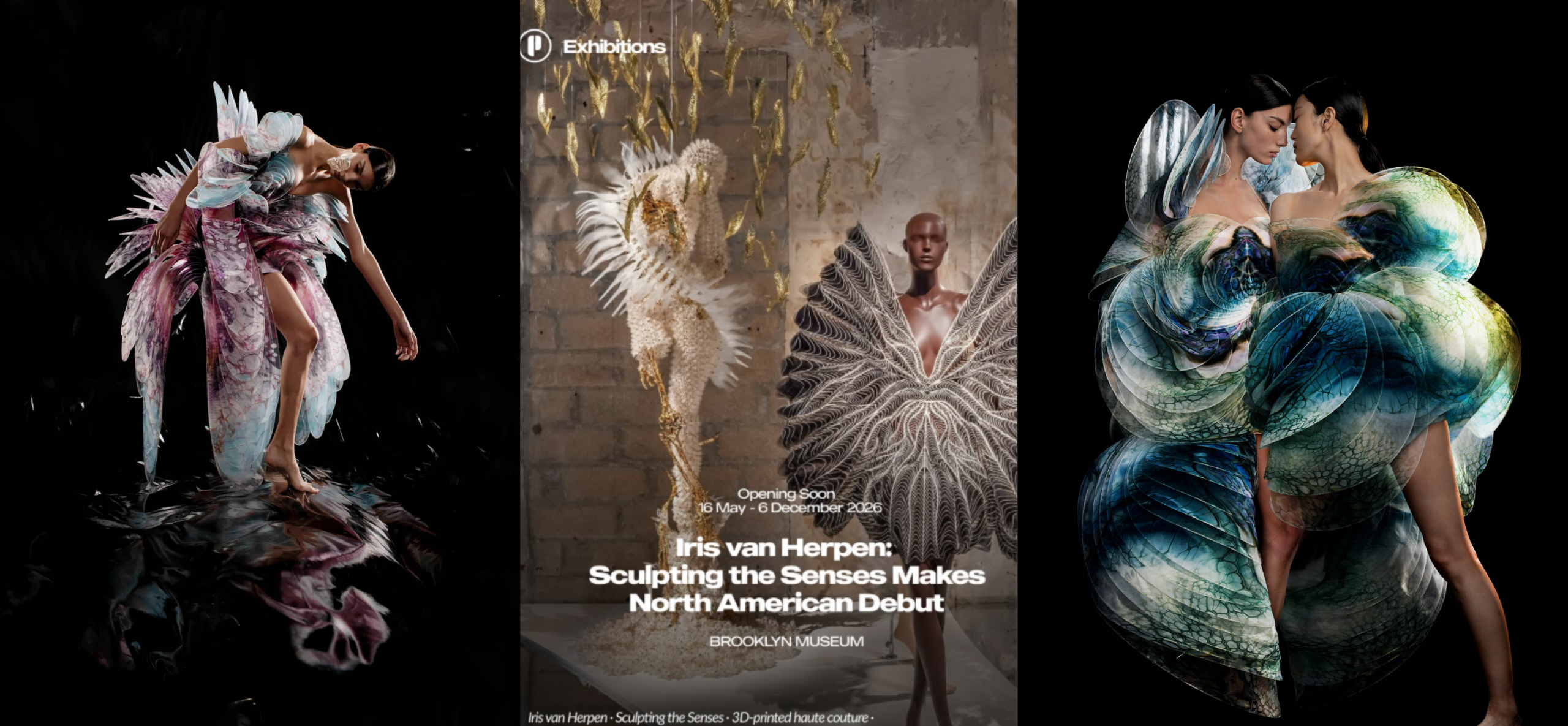

Few designers have tested the limits of haute couture as persistently as Iris van Herpen. Since establishing her Amsterdam maison in 2007, she has developed a practice in which fashion moves through architecture, biology, engineering, contemporary art and science, bringing disciplines rarely associated with the traditional atelier into the construction of clothing.
That approach is given unusual scale at Iris van Herpen: Sculpting the Senses, on view at the Brooklyn Museum from May 16 to December 6, 2026. First presented at the Musée des Arts Décoratifs in Paris in 2023 before travelling internationally, the exhibition makes its North American debut in Brooklyn and marks the designer’s first major New York presentation. More than 140 haute couture creations appear alongside contemporary artworks, scientific artefacts, natural history specimens and archival material, tracing almost two decades of work that has consistently questioned where fashion ends and other creative disciplines begin.
The exhibition arrives at a moment when technologies once largely confined to laboratories and specialist industries are becoming increasingly relevant to design. New approaches to fabrication and materials have expanded what designers can make, while debates around artificial intelligence and automation have made the relationship between human creativity and technology more complicated. Van Herpen’s work offers no simple answer to these questions, but her career provides a particularly sustained example of what can emerge when fashion allows knowledge from other fields to influence both its ideas and its methods.
When technology changes construction
Fashion’s fascination with the future is hardly new. Metallic surfaces, synthetic fabrics and machine-inspired silhouettes have been used for decades to suggest technological progress, often without fundamentally changing the way a garment was conceived or made. In Van Herpen’s work, technological experimentation reaches further into the construction process, influencing the structure and material possibilities of the clothes themselves.
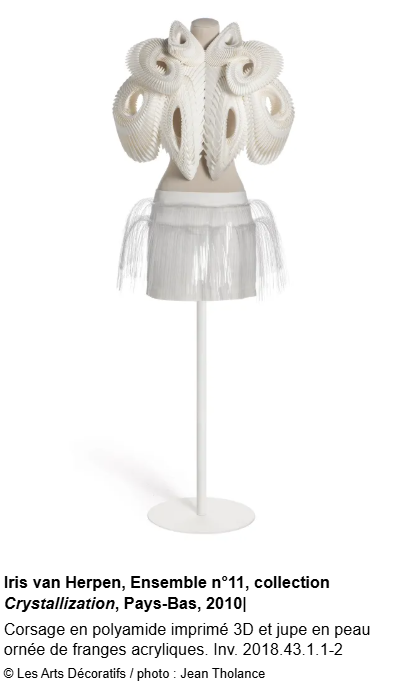
In 2010, her Crystallization collection included what the Brooklyn Museum identifies as the first 3D-printed dress presented on a runway. Since then, digital fabrication and unconventional manufacturing methods have developed alongside handwork within her collections, creating a vocabulary in which advanced technology and traditional couture increasingly occupy the same garment.
In 2010, her Crystallization collection included what the Brooklyn Museum identifies as the first 3D-printed dress presented on a runway. Since then, digital fabrication and unconventional manufacturing methods have developed alongside handwork within her collections, creating a vocabulary in which advanced technology and traditional couture increasingly occupy the same garment.
This distinction matters more than the futuristic appearance for which her work is often recognised. A garment can evoke another world while being produced through familiar methods, whereas Van Herpen has repeatedly questioned the methods themselves, using technological processes to explore surfaces, structures and forms that would be difficult to achieve through conventional construction alone.
Yet the precision of digital fabrication rarely replaces the hand entirely. Instead, technological processes are combined with the knowledge of the atelier, allowing new tools to extend existing forms of craftsmanship. Her work therefore complicates the familiar opposition between technological innovation and artisanal skill, suggesting that couture can evolve by allowing both to inform one another.
Nature as a system, not an ornament
Technology represents only one side of Van Herpen’s practice. Nature has remained an equally persistent source of research, though rarely through the conventional language of floral motifs or decorative references.
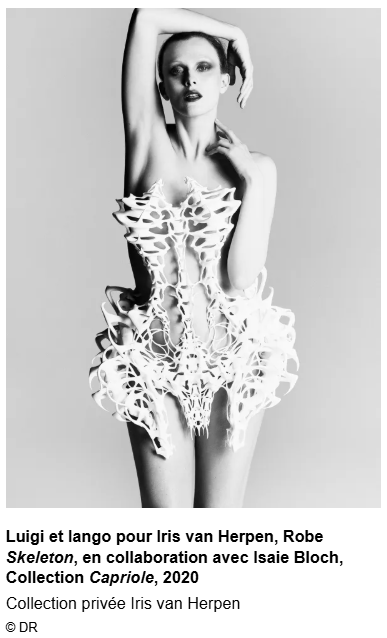
Her collections have drawn on biomimicry, marine biology, mycology, neuroscience, mathematics and astronomy, translating coral formations, skeletal structures, branching fungi, waves and planetary movement into questions of volume, surface and motion. Nature becomes less an image to reproduce than a system to observe, offering models for how a garment might grow, respond to movement or occupy the space surrounding the body.
At the Brooklyn Museum, those relationships become particularly visible. Van Herpen’s designs are presented alongside coral, fossils and skeletons, as well as works by artists, architects and designers including Philip Beesley, Rogan Brown, Nick Knight and Jacques Rougerie. These objects provide more than context. They reveal the network of ideas surrounding the clothes and the extent to which observation of the natural world has shaped their development.
Some garments appear fluid despite the complexity of their structures, while others recall organisms, geological formations or anatomical systems more readily than familiar textiles. Their ambiguity is part of their appeal, allowing something meticulously engineered to appear simultaneously fragile, organic and almost alive.
This refusal to separate apparently opposing ideas has become one of the most distinctive qualities of Van Herpen’s work. Nature and technology continually inform each other, while computational processes coexist with techniques that depend on the precision of the human hand. Rather than choosing between these approaches, her collections explore what becomes possible when the boundaries between them begin to dissolve.
Collaboration changes the role of the designer
Fashion continues to place considerable emphasis on the singular vision of the creative director, yet Van Herpen’s practice has long been shaped by exchange. Scientists, architects, artists, engineers and other specialists enter the development of her collections, contributing forms of knowledge that sit outside traditional fashion training.
These collaborations extend beyond visual inspiration because they can influence the processes through which garments are developed. In doing so, they complicate the familiar idea of authorship in fashion, replacing the image of an isolated designer with a creative practice built through dialogue between different areas of expertise.
As materials and manufacturing processes become increasingly specialised, this way of working feels particularly relevant. Innovation can require knowledge that no individual designer could reasonably possess, making the ability to understand and connect different disciplines increasingly valuable. Van Herpen has made that exchange visible throughout her career, treating fashion as a meeting point where scientific, artistic and technical ideas can be translated into material form.
Seen differently inside a museum
A museum inevitably alters the way these garments are encountered. Couture collections normally unfold within minutes before being photographed, reviewed and circulated across digital platforms, while an exhibition allows the same pieces to be considered at a pace closer to the processes through which they were originally created.
Sculpting the Senses makes use of that slower encounter through nine thematic sections exploring subjects including water, anatomy, movement, sound, light and the interconnected systems of nature, rather than organising Van Herpen’s career through a straightforward chronology. An evocation of her atelier brings some of the tactile processes behind the clothes into the exhibition, while a soundscape by composer Salvador Breed extends the experience beyond the visual.
This setting draws attention towards aspects that runway imagery can struggle to communicate. Construction becomes easier to examine, relationships between seemingly unrelated references become clearer and individual garments can be understood within the research that informed them. Their significance lies not only in silhouette, but in the questions behind their construction and the range of knowledge required to make them possible.
Seen within this broader context, Sculpting the Senses does more than trace nineteen years of collections. It reveals the development of a creative method in which experimentation has gradually become inseparable from the clothes themselves.
Couture as a place for research
Haute couture remains one of fashion’s rare environments where time, specialised expertise and experimentation can coexist without the same demands imposed on industrial production. Van Herpen has used that freedom to pursue ideas whose value does not necessarily depend on whether they can immediately be reproduced at scale.
A new technique can begin instead with a question about material, movement or construction, allowing the atelier to test possibilities before their wider applications are known. Not every experiment developed within couture will become an industry solution, nor should every unusual garment be treated as a prediction of how people will dress in the future. Research can be valuable precisely because its outcome has not yet been decided.
That distinction becomes increasingly relevant as fashion confronts questions surrounding resources, manufacturing and technological change. Experimental couture cannot resolve those challenges alone, but it can provide a space where assumptions about materials and production are tested rather than simply accepted.
Van Herpen’s relevance therefore reaches beyond the relatively small world of couture clients and museum collections. Her practice demonstrates how a garment can function as a form of research, bringing together materials, technologies and ideas whose broader implications may only become apparent later.
Fashion with room to imagine
Innovation is an obvious way to describe work this technologically complex, but concentrating on it too heavily risks overlooking the more poetic quality that has allowed Van Herpen’s designs to remain distinctive even as the technologies surrounding them have changed.
Her clothes rarely present technology as something cold or detached from the body. They ripple, expand and appear to breathe, while rigid structures evoke water and engineered surfaces recall skin, wings, skeletons or microscopic organisms. Scientific research becomes a way of approaching sensations and forms that conventional clothing cannot always express.
Sculpting the Senses captures that aspect of her practice particularly well. The title refers not simply to the physical qualities of the garments but to a way of thinking in which the body remains connected to material, technology and its surrounding environment. Across the exhibition, clothing provides the point of departure for a much wider investigation into how those relationships might be understood.
At a moment when much of the industry is expected to move quickly, produce continuously and respond almost immediately to change, Van Herpen represents another approach to progress, one built through research, collaboration and the willingness to pursue an idea beyond the familiar vocabulary of fashion.
Her contribution cannot be reduced to bringing new technology into couture. Over almost two decades, she has used clothing to question the divisions between disciplines that fashion once treated as fixed, leaving behind a definition of couture that feels considerably more open than the one she inherited.
May