
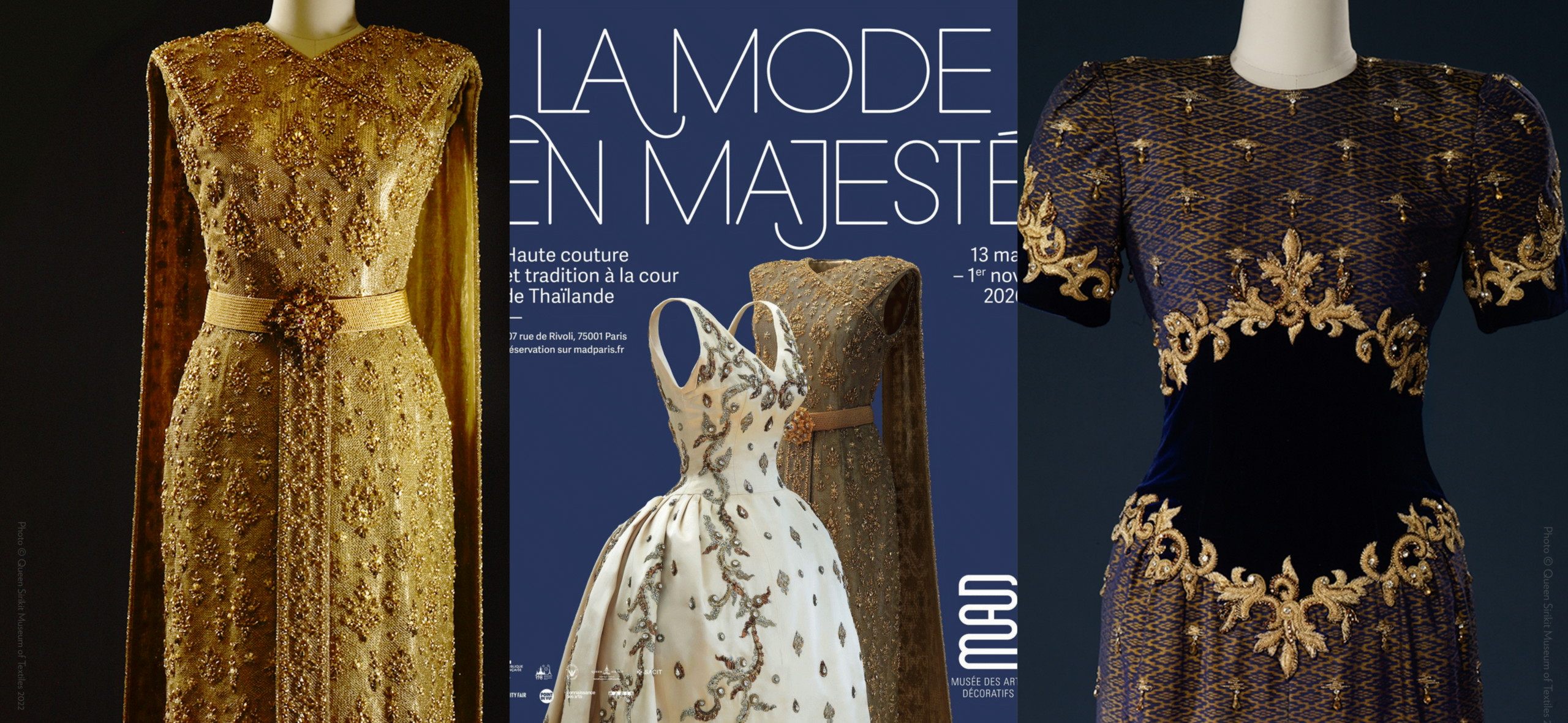

Queen Sirikit’s wardrobe brought Thai silk, historic forms and Paris couture into the visual language of twentieth-century diplomacy. La Mode en Majesté looks beyond royal style to a period in which clothing became closely involved in how modern Thailand represented itself.
In 1960, Queen Sirikit of Thailand embarked on an international tour that would take her and King Bhumibol Adulyadej through the United States and fifteen European countries. The journey placed the young queen before political leaders, international press and audiences largely unfamiliar with Thailand. Her wardrobe therefore carried an unusual responsibility. It needed to navigate the conventions of diplomatic dress while offering a recognisably Thai image of a country negotiating its place on the international stage.
Preparing for that moment had begun years earlier. Queen Sirikit worked with historians, court figures and Thai designers to study surviving garments, photographs and records of earlier court dress, eventually developing eight forms of national dress between 1958 and 1964. At the same time, she turned to Pierre Balmain for the Western wardrobe required by the tour, beginning a relationship between Bangkok and Paris that would continue for decades and later involve the embroidery house Lesage.
Clothing sits at the centre of this history, but it was never merely decorative. Thai silks and court traditions became part of a modern national image, couture techniques entered into dialogue with local forms, and Queen Sirikit’s later patronage of weaving communities connected the visibility of royal dress to the survival of regional textile knowledge.
La Mode en Majesté. Royal Thai Dress from Tradition to Modernity, presented by the Musée des Arts Décoratifs in Paris until 1 November 2026, brings these strands together through garments and accessories from the royal collections. Rather than treating the wardrobe simply as a succession of exceptional dresses, the exhibition offers an opportunity to examine how fashion can participate in the construction of national identity and how a garment worn before an international audience can operate simultaneously as dress, diplomacy and cultural representation.
National dress
Queen Sirikit’s development of a modern Thai royal wardrobe cannot be separated from the political and cultural circumstances in which it appeared. By the middle of the twentieth century, the relationship between clothing and Thai identity had already undergone significant change. Court dress had progressively incorporated Western influences since the nineteenth century, while a 1941 government decree promoted Western clothing as part of Thailand’s modernising project. According to research by the Queen Sirikit Museum of Textiles, post-war Thailand consequently lacked a single national form of women’s dress comparable in function to the sari in India or kimono in Japan.
That absence became particularly visible as King Bhumibol Adulyadej and Queen Sirikit prepared for an extensive international tour in 1960. Their journey took them to the United States and fifteen European countries over seven months, placing the young royal couple before international political leaders, press and public audiences. Queen Sirikit understood that her appearance would inevitably be read as a representation of Thailand itself.
Preparations for her Thai wardrobe had begun nearly two years earlier. Rather than selecting an existing historical costume and reproducing it, Queen Sirikit assembled advisers including historians, women of the court, her Thai designer Urai Lueumrung and other local designers. They studied surviving court textiles and photographs dating from approximately 1850 to 1925, looking to traditional wrapped and draped garments including the phaa nung hip wrapper and sabai shoulder cloth. Those references were then adapted through modern construction techniques.
Eight forms of national dress eventually emerged between 1958 and 1964, designed for different degrees of formality and different social occasions. Their importance lies partly in that deliberate construction. These clothes were connected to Thai dress history, but they were not presented as untouched survivals from an earlier period. Historical references were selected, studied and reformulated to create a wardrobe capable of representing a contemporary nation.
Tradition and modernity
Fashion often treats tradition as something inherited intact, yet Queen Sirikit’s wardrobe demonstrates how actively tradition can be shaped. A garment such as Thai Chakri makes that process particularly visible. One of the eight national styles, it combines a formal skirt with a front pleat and a traditional shoulder cloth, generally using silk woven with gold or silver metal thread. Its silhouette immediately refers to established Thai forms, while its construction belongs to a twentieth-century wardrobe designed to function at state banquets, diplomatic receptions and other highly codified occasions.
Thai Dusit takes another route. Intended as formal evening dress, the style combines a Western-influenced sleeveless fitted bodice with a traditional Thai skirt, often in richly woven brocade. A 1963 example by Pierre Balmain incorporates silk, sequins, beads and gold and silver metal threads, bringing Thai textile traditions into direct contact with the techniques and vocabulary of Paris couture.
Seen together, the eight styles complicate any easy opposition between tradition and modernity. Modernisation did not require Thai dress to become Western, just as preserving Thai identity did not require royal clothing to remain fixed in historical forms. The wardrobe instead developed a controlled visual language in which recognisable elements of Thai dress could move into contemporary diplomatic life.
That distinction matters because national dress can easily be interpreted as evidence of an unchanging cultural past. Here, it is closer to design. Historical sources supplied material, silhouette and symbolism, while decisions about construction, formality and presentation adapted those references to a different social and political moment. La Mode en Majesté consequently presents fashion not simply as a reflection of national identity, but as one of the means through which that identity can be articulated.
Bangkok and Paris
Pierre Balmain entered this story initially for a different reason. Queen Sirikit needed a Western wardrobe appropriate to the seasons, occasions and protocol of the 1960 tour, and commissioned the Paris couturier to create daytime ensembles, cocktail dresses, evening gowns and outerwear. Balmain also coordinated accessories, producing a remarkably complete wardrobe for a queen who would spend months appearing before international audiences.
Their collaboration did not end with Western dress. Balmain and embroiderer François Lesage later became involved in the development of Queen Sirikit’s Thai national wardrobe, creating variations on the established styles and working with Thai silks and traditional court brocades. A 1964 evening dress in Thai national style, for example, combined Thai silk and a silk-and-gold-metal-thread phaa yok skirt with sequin embroidery. Another ensemble commissioned for an official visit to Iran in 1967 used European silk and metal-thread brocade almost entirely covered by Lesage embroidery.
It would be easy to read these pieces principally through the prestige of Paris couture. Doing so, however, risks placing Balmain at the centre of a story that began with Queen Sirikit’s own project and with research into Thai clothing history. The relationship is more interesting as an exchange of techniques. French couture offered particular methods of construction and embroidery, while Thai textiles supplied materials, histories and forms that altered the resulting garments.
That exchange continued for more than three decades, first through Pierre Balmain and later through the house and its designers, including Erik Mortensen. The exhibition includes a 1985 Mortensen dress in mat mii silk ikat and velvet, embroidered by Lesage with rhinestones, gold thread, beads and sequins. The garment sits at an intersection that had become characteristic of Queen Sirikit’s wardrobe: Thai textile production, European couture construction and Parisian embroidery occupying the same object.
State visits
Clothes designed for diplomatic life have two audiences. They must function correctly within the immediate setting, but they are also reproduced through official photographs, newspapers and television, often reaching far beyond the room in which they were worn. Queen Sirikit’s wardrobe was particularly suited to that second life.
During international visits, she moved between Western couture and Thai national dress depending on the occasion. Balmain evening gowns could establish her fluency within an international language of elite fashion, while Thai dress offered a distinct visual identity rooted in the country she represented. Some garments brought those categories together. Balmain made Western-style evening dresses from Thai silk and traditional court brocades, allowing the material itself to carry a Thai association even when the silhouette belonged more clearly to European couture.
Individual garments accumulated diplomatic histories through use. A Thai Chakri dress made by Balmain in 1967 was worn during a state visit to the United States, including a visit to the Metropolitan Museum of Art in New York, before appearing again in Bangkok for a theatre engagement and later at a state banquet for the President of India. The same piece therefore moved between foreign representation and domestic ceremony, its meaning changing slightly with each setting.
Royal dress has long performed this kind of symbolic work, but Queen Sirikit’s wardrobe is notable for the degree to which its language was consciously developed. Clothing could communicate modernity without abandoning cultural specificity, while Thai textiles could appear within settings where Western couture remained an important marker of international elegance. Diplomacy was not printed onto the garments as a message. It operated through the balance of references they carried.
Weaving traditions
By the 1970s, Queen Sirikit’s use of clothing became connected to another project. During travels within Thailand, she had encountered regional weaving traditions whose economic survival was increasingly precarious. The SUPPORT Foundation, established in 1976, encouraged rural communities to produce handwoven textiles and other crafts as a source of supplementary income, particularly during periods when agricultural work alone could not provide sufficient support.
Preservation in this context was tied to production rather than simply conservation. SUPPORT encouraged the continuation of silk and cotton weaving and, in some cases, helped revive techniques that had disappeared locally. In Nakhon Si Thammarat, for example, a tradition of phaa yok brocade associated with the nineteenth-century royal court had ceased by the early twentieth century. The foundation supported its revival by bringing in expertise to retrain local weavers.
Queen Sirikit then used her own wardrobe to increase the visibility of those textiles. From the late 1970s, Thai and European designers transformed village-woven SUPPORT fabrics into clothing for royal appearances at home and abroad. Balmain and Lesage participated in this process, adapting handwoven Thai silks to Western fashion forms as well as national dress.
This gives the wardrobe an economic dimension that is easily lost when royal clothes are displayed primarily for their beauty. Wearing a textile at a state event could give a regional weaving tradition international visibility, linking the prestige of royal dress to the labour of craftspeople far from the court. It also turned the wardrobe into a form of advocacy for Thai textile production, although one operating through royal patronage rather than through the contemporary language of fashion development programmes.
Craft as cultural continuity
Much of the visual power of La Mode en Majesté inevitably comes from material. Silk, metallic brocade, embroidery, beads and sequins create the kind of surfaces that museums can present spectacularly, particularly when garments once designed for ceremonial settings are isolated under exhibition lighting. Yet focusing solely on their richness would miss why these materials occupy such an important place in the story.
Textiles can preserve knowledge in ways that extend beyond the finished object. Weaving requires techniques passed between generations, familiarity with fibres and dyes, regional patterns and forms of labour that cannot necessarily be reconstructed once a community stops practising them. Queen Sirikit’s textile initiatives recognised that preservation depended partly on ensuring that these skills continued to have economic and social value.
Her wardrobe offered one mechanism for doing so. Traditional cloth was not confined to ethnographic preservation or reproduced only in historical costume. It could become a Balmain evening dress, a royal ensemble or a contemporary interpretation while remaining identifiable through its material and technique. This approach inevitably changed the context in which the textiles appeared, but it also kept them within a living system of production.
That legacy continues beyond Queen Sirikit’s own wardrobe. The Musée des Arts Décoratifs points to Queen Suthida’s current patronage of the foundation’s mission and to Princess Sirivannavari’s work as a designer supporting Thai creators and the contemporary use of traditional textiles. The exhibition therefore extends into the present rather than closing its narrative with the couture collaborations of the twentieth century.
Paris 2026
Showing this wardrobe in Paris gives the exhibition another layer. France is not a neutral setting for garments shaped partly through collaboration with Balmain and Lesage, and the diplomatic anniversaries surrounding the exhibition make that relationship explicit. La Mode en Majesté arrives 340 years after Siam’s first diplomatic mission to France and 170 years after the establishment of formal relations between the two countries.
Yet the exhibition is most compelling when that Franco-Thai connection is understood as only one part of the story. Paris couture contributed expertise and international fashion visibility, but the foundations of Queen Sirikit’s national wardrobe came from Thai historical research, court dress, local designers and textile traditions. Its later evolution became tied to rural weaving communities and attempts to sustain skills across different regions of Thailand.
This makes the clothes difficult to categorise neatly. They are royal garments and couture objects, but they are also products of historical research, diplomatic strategy and craft preservation. Some were designed to represent Thailand abroad, some placed Thai textiles inside Western silhouettes and others helped establish forms of national dress that remain recognisable decades later.
Fashion exhibitions often rely on beauty as an entry point, and La Mode en Majesté has no shortage of it. Its richer argument lies elsewhere. Queen Sirikit’s wardrobe shows that national identity in dress does not have to emerge from the preservation of an untouched past. It can be researched, constructed and adapted, drawing selectively from history while responding to the demands of the present. In this case, clothing became a way to present a modern Thailand internationally without making modernity synonymous with abandoning Thai visual and material culture.
That is what makes the exhibition more than a study of royal style. The dresses record negotiations between local and international fashion, inherited techniques and new construction, ceremony and politics. Their silk and embroidery remain striking, but their significance lies in what those materials were asked to represent.
May