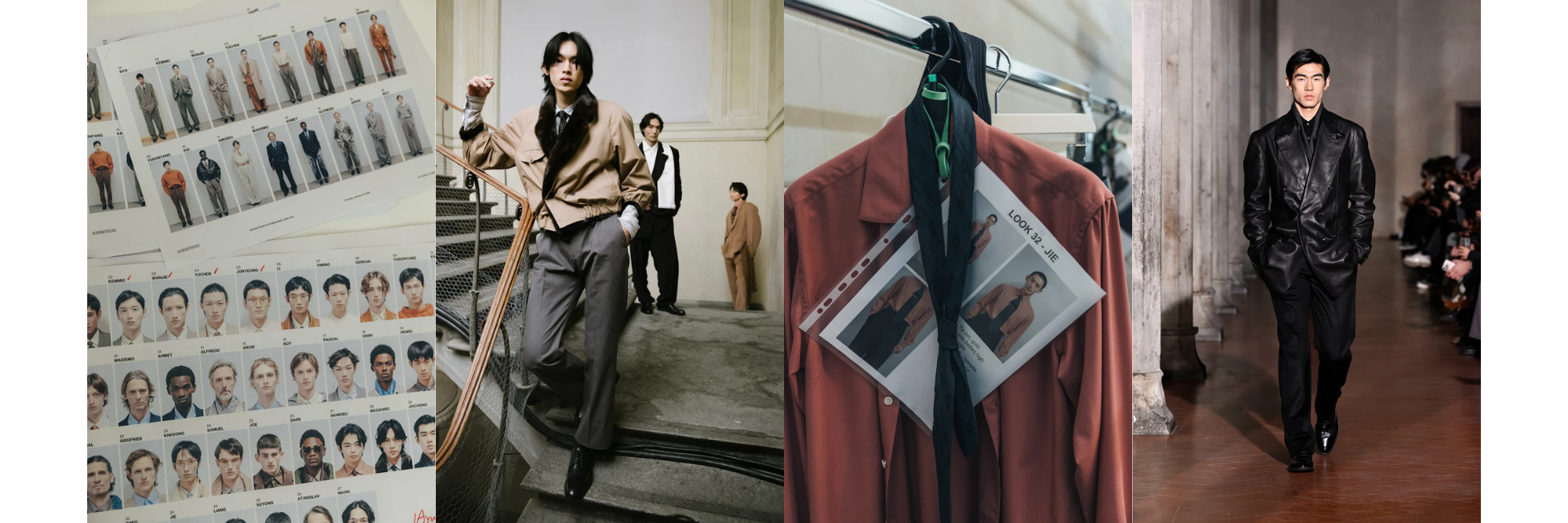

Every fashion season begins long before most people realise it.
January rarely arrives with the anticipation surrounding couture or the visibility of the September collections. Yet it is often the month that reveals where fashion is heading first. Before the headlines multiply and the calendar gathers pace, menswear introduces the ideas that will shape the year ahead.
There is something fitting about that timing. The colder months naturally invite a different way of thinking about clothes. Fabrics become heavier, layering becomes instinctive and construction comes into sharper focus. Fashion feels less concerned with immediate impact and more attentive to how garments are made and how they will be worn.
In 2026, that shift was impossible to ignore.
Across Florence, Milan and Paris, designers approached menswear with unusual clarity. Collections favoured thoughtful evolution over dramatic reinvention, suggesting an industry looking beyond seasonal novelty towards wardrobes built with greater longevity in mind.
Florence: The trade pulse
Between 13 and 16 January, Pitti Uomo returned to Florence for its 109th edition, bringing together more than 750 brands inside the Fortezza da Basso. Buyers, editors, manufacturers and designers gathered to present the Fall/Winter 2026 to 2027 season, turning the city into the first major meeting point of the fashion calendar.
Pitti occupies a distinctive place within that calendar. Unlike the runway, where collections are experienced in a matter of minutes, the fair encourages a slower kind of observation. Buyers examine fabrics up close, designers discuss new developments with manufacturers and conversations unfold across exhibition spaces rather than backstage corridors. It is one of the few moments where fashion can still be appreciated as an object before it becomes an image.
The 2026 edition, organised around the theme Pitti Bikes, reflected an industry in motion. Beyond the bicycle motif that ran throughout the event, the fair explored changing consumer expectations, technological innovation and the growing importance of responsible production. Emerging designers appeared alongside established manufacturers, reinforcing Pitti Uomo’s role as the place where commercial realities meet creative ambition.
The collections themselves revealed a preference for permanence over novelty. Relaxed tailoring retained its precision, outerwear balanced function with craftsmanship and natural materials such as wool, leather and cashmere dominated many presentations. Muted palettes allowed construction and fabrication to take precedence, while branding receded into the background.
Pitti rarely announces the loudest trends. More often, it reveals the quieter shifts that gradually reshape the industry.
Milan: Precision without excess
The calendar moved to Milan from 16 to 20 January, where more than seventy physical and digital events brought together Italy’s leading houses and a growing number of independent voices. If Florence reflected the industry’s commercial foundations, Milan demonstrated how those ideas could be refined through design.
Italian menswear has long been associated with tailoring, proportion and material excellence. This season those qualities felt particularly assured, not because they had been reinvented, but because designers approached them with renewed confidence.
Silhouettes became cleaner, shoulders softened, coats extended in length and knitwear assumed a more prominent role throughout the collections. Colour remained understated, favouring charcoal, olive, tobacco, midnight blue and winter neutrals that allowed texture to carry much of the visual interest.
A similar mindset shaped the collections more broadly. Many designers appeared less interested in introducing an entirely new wardrobe than in refining the one that already exists. Pieces were conceived to age well, encouraging longevity over constant replacement.
Innovation remained present, though it was expressed through material, construction and proportion rather than visual excess.
Paris: Ideas take shape
From 20 to 25 January, Paris concluded the menswear season with a calendar that brought together heritage houses, independent designers and emerging talent. Where Florence establishes conversations and Milan refines them, Paris often becomes the place where those ideas take on their fullest expression.
Clothing remained central, but so did the narratives surrounding it.
At Louis Vuitton, Pharrell Williams continued to develop a more mature menswear vocabulary, favouring refined tailoring and carefully considered proportions over overt visual statements. Hermès, meanwhile, marked an important moment in its history as Véronique Nichanian presented what would become her final menswear collection after decades shaping one of fashion’s most consistent and enduring identities.
Across the week, another shift became increasingly apparent. Collections relied less on theatrical staging to communicate their message. Materials, construction and silhouette assumed greater importance, while logos became less prominent and brand identities appeared more assured without relying on constant visual amplification.
Paris remained the most expressive stop on the calendar, though its confidence came increasingly from precision rather than scale.
A quieter vision of luxury
Viewed together, the three cities pointed towards a common understanding of luxury.
Across the month, value appeared increasingly tied to longevity rather than immediacy. Garments were designed to become part of a lasting wardrobe instead of serving as fleeting seasonal statements. Craftsmanship moved to the foreground, while fabric, proportion and construction carried more weight than overt branding.
That does not suggest fashion has become less inventive. On the contrary, creativity increasingly lies in refinement rather than disruption.
At a time when digital culture rewards constant novelty, January proposed a slower rhythm. It suggested that the future of luxury may depend less on creating the next viral image than on producing garments capable of remaining relevant long after the season has passed.
What remains
Menswear rarely defines an entire year, but it often reveals the direction in which the industry is beginning to move.
The opening weeks of 2026 suggested a fashion landscape looking beyond immediate impact in favour of durability, precision and thoughtful design. Change was present throughout the month, though it emerged through careful evolution rather than dramatic reinvention.
By the time the women’s collections begin and the calendar gathers speed once again, January has already fulfilled its role.
It has quietly established the tone for everything that follows.
May