

Few designers have returned to memory as consistently as Erdem Moralıoğlu. For two decades, forgotten women, inherited textiles and literary heroines have shaped collections that feel as though they belong to another time without ever becoming historical recreations. His work has never been about preserving the past exactly as it was. Instead, memory becomes something to cut apart, reshape and reinterpret, allowing familiar stories to evolve rather than remain fixed.
Presented during London Fashion Week as the house marked its twentieth anniversary, Fall/Winter 2026 turned that idea back towards Erdem itself. Anniversary collections often encourage designers to revisit the silhouettes that defined their careers, but Moralıoğlu resisted that temptation. Rather than celebrating the archive, he questioned how it changes over time. What happens when the memories attached to a garment begin to shift? Which details remain, and which quietly disappear?
The collection never felt retrospective. It felt alive, treating the archive less as a destination than as the beginning of another conversation.
Fragments instead of replicas
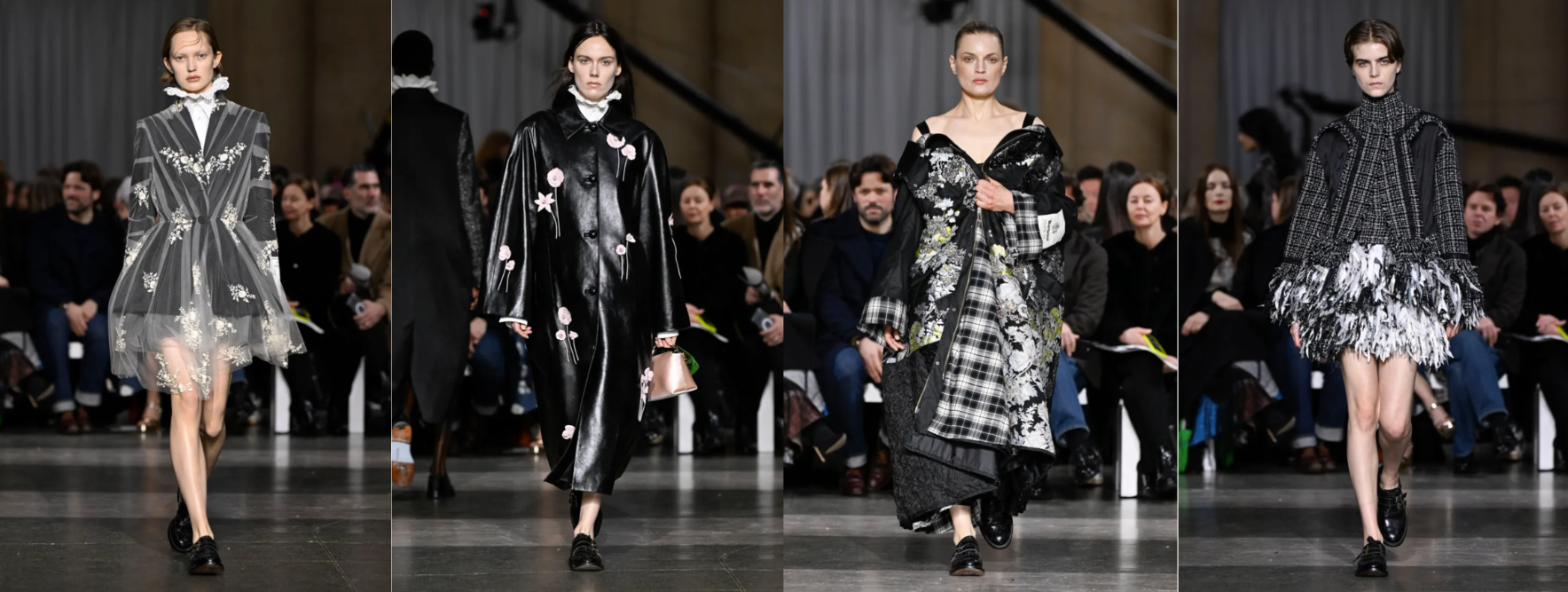
That conversation started with garments from previous collections. According to Moralıoğlu, they were dismantled, examined and reconstructed, allowing familiar elements to return in altered forms rather than as direct reproductions. Florals interrupted by lace, embroidery dissolving into transparent fabrics before resurfacing elsewhere, and fragments of different garments brought together within a single silhouette all contributed to the impression that the collection had grown out of its own history.
What emerged was not nostalgia, but continuity. The clothes carried traces of earlier lives without becoming trapped by them, acknowledging the past while refusing to simply recreate it. Every reconstruction suggested that the archive remains valuable not because it is carefully preserved, but because it can continue to change.
Memory in the details
That same process unfolded across the fabrics themselves. Florals, one of the house’s most recognisable signatures, appeared softened and partially obscured, layered beneath lace or interrupted by unexpected textures until they no longer looked entirely complete. The embroidery followed a similar path, fading into sheer surfaces before quietly returning elsewhere across the collection.
These interruptions altered the way the garments were read. The eye no longer moved effortlessly across each look but slowed down, discovering details gradually instead of taking them in at once. In a runway presentation where impressions are often immediate, Moralıoğlu invited a different pace, one where construction became more rewarding the longer it was observed.
That sense of incompleteness proved surprisingly expressive. Beauty emerged not from flawless restoration but from visible transformation, allowing each garment to retain the marks of what it had once been.
Craftsmanship and memory
The collection’s construction reinforced that same idea without drawing attention away from it. Dense jacquards gave structure without stiffness, velvet absorbed light to create depth and lace connected contrasting fabrics with remarkable precision. Decorative techniques rarely served as ornament alone. Each contributed to the architecture of the garment, supporting the broader narrative of reconstruction that ran throughout the collection.
Nothing announced itself immediately. The richness of the work became apparent through proportion, texture and finish, rewarding careful observation rather than relying on a dramatic first impression. It was a reminder that craftsmanship is often most compelling when it reveals itself gradually.
A softer silhouette
Silhouettes followed the same philosophy. Volume appeared throughout the collection, though it remained controlled, allowing sleeves, skirts and layers to expand before naturally returning towards the body. Transparency suggested vulnerability without becoming overtly revealing, while movement took precedence over theatrical proportion.
Much contemporary fashion continues to explore transformation through increasingly exaggerated silhouettes. Moralıoğlu pursued something quieter. His clothes seemed designed to move with the wearer instead of reshaping them, creating garments that expressed character without overwhelming it.
That balance has become one of Erdem’s defining qualities. Across twenty years, the house has built a recognisable visual language without relying on repetition, refining familiar ideas season after season instead of constantly replacing them.
Twenty years later
Looking back was unavoidable, but looking backwards was never the collection’s purpose.
Memory, literature, craftsmanship and femininity have shaped Erdem since its beginnings, yet none of those themes returned unchanged. Like the garments themselves, they had evolved through time, altered by new experiences and new ways of reading the archive.
That approach made the anniversary feel unusually relevant. Memory is never static. Some details fade while others unexpectedly sharpen, and every recollection is influenced by the present. By applying that same logic to his own work, Moralıoğlu transformed the archive into something living rather than historical.
Looking forward
Many anniversary collections become exercises in celebration. This one became an exercise in reflection.
Long after the final look, what remained was not a single silhouette or one defining image, but the impression that every garment had already travelled through time before arriving on the runway. Interrupted florals, reconstructed fabrics and quietly complex construction all contributed to a collection that revealed itself gradually, asking the audience to look a little longer.
Marking twenty years of the house could easily have encouraged Erdem Moralıoğlu to revisit familiar successes. Instead, he demonstrated that longevity depends less on preserving an established language than on allowing it to evolve. The archive was not presented as a finished story. It became material for the next chapter.
May