
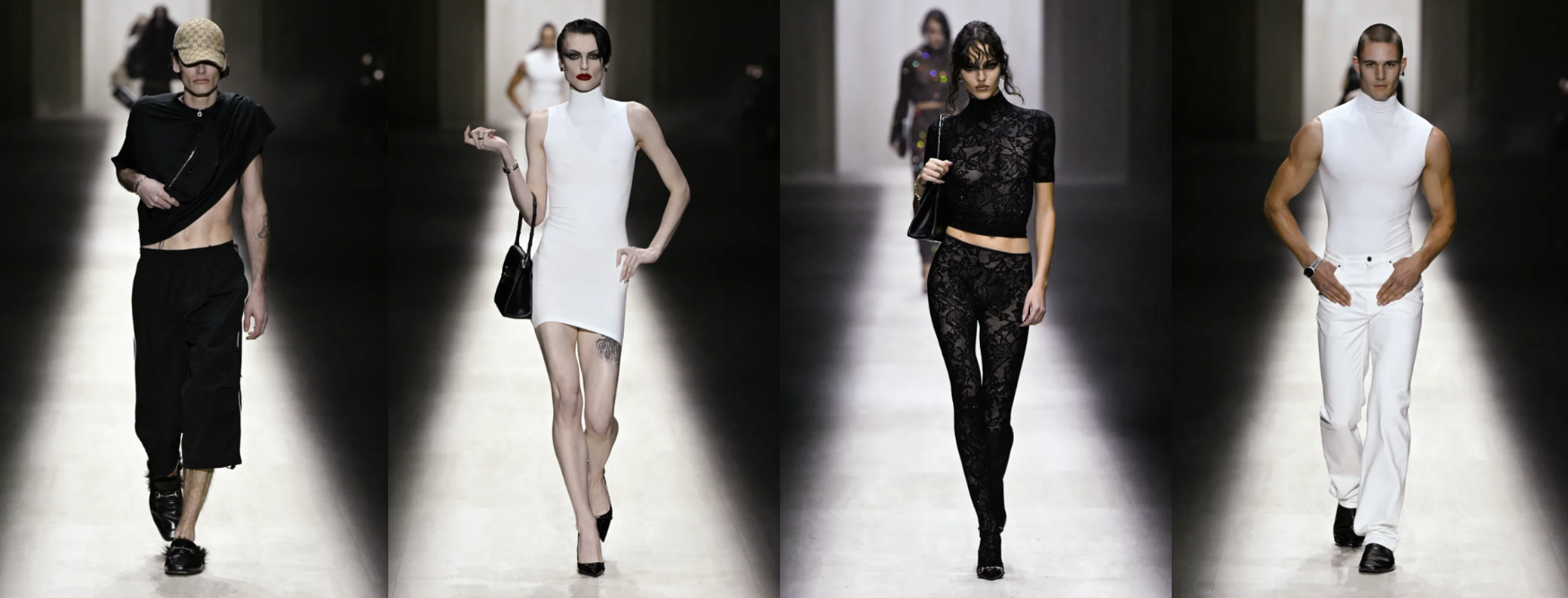

Few collections in Milan carried as much expectation as Gucci, yet the anticipation surrounding the show was unlike that of a typical creative debut. Editors, buyers and industry observers were not waiting for a radical new vision or a defining statement. They had come to witness something far less common, a house suspended between two creative eras.
Following Sabato De Sarno’s departure and ahead of Demna’s arrival, Fall/Winter 2026 was developed by Gucci’s design studio. The circumstances inevitably shaped the way the collection was read. Instead of looking for signs of the future, attention turned to the present, to the identity of a house navigating the space between two creative directors while remaining unmistakably itself.
That sense of continuity ran through the collection from the opening look. Long coats established clean, elongated silhouettes, tailoring remained precise without becoming severe, and fluid eveningwear introduced movement with quiet confidence. Nothing suggested an attempt to redefine Gucci overnight. The collection relied on familiar codes, allowing proportion, construction and material to carry the narrative instead of novelty.
Styling followed the same measured approach. Layers became lighter, accessories never distracted from the clothes and every silhouette was given room to breathe. The collection rewarded careful observation. Details emerged gradually through the dialogue between garments, encouraging the eye to linger instead of searching for an immediate statement.
The silhouettes remained equally controlled. Coats fell almost to the ankle, extending the body’s natural line, while narrow trousers and softly draped dresses created a wardrobe built on precision instead of exaggeration. Small adjustments in proportion proved enough to alter the character of familiar pieces, demonstrating how subtle shifts can transform an entire collection without relying on dramatic gestures.
Material played an equally important role. Dense wool retained its structure while remaining fluid in movement, leather appeared supple and understated, and silk softened the sharper elements of the wardrobe. Nothing felt designed to dominate the eye. Texture, weight and construction unfolded gradually, revealing the craftsmanship through the way each garment moved rather than through decorative excess.
There was something quietly assured about that decision. The Gucci studio resisted the temptation to imitate the past or anticipate what Demna might soon introduce. Instead, it concentrated on building a coherent wardrobe grounded in the house’s established vocabulary. In doing so, the collection suggested that continuity can be an intentional creative position in its own right, not simply the absence of change.
Seen alongside the wider Milan calendar, Gucci offered one of the season’s most thoughtful reflections on identity. While many houses explored renewal through reinvention, Gucci chose to pause, refining what already existed before turning the page. Fall/Winter 2026 may ultimately be remembered not as the beginning of a new era, but as the collection that preserved the thread between two of them. Sometimes, the quietest chapter reveals the most about a house’s character.
May