
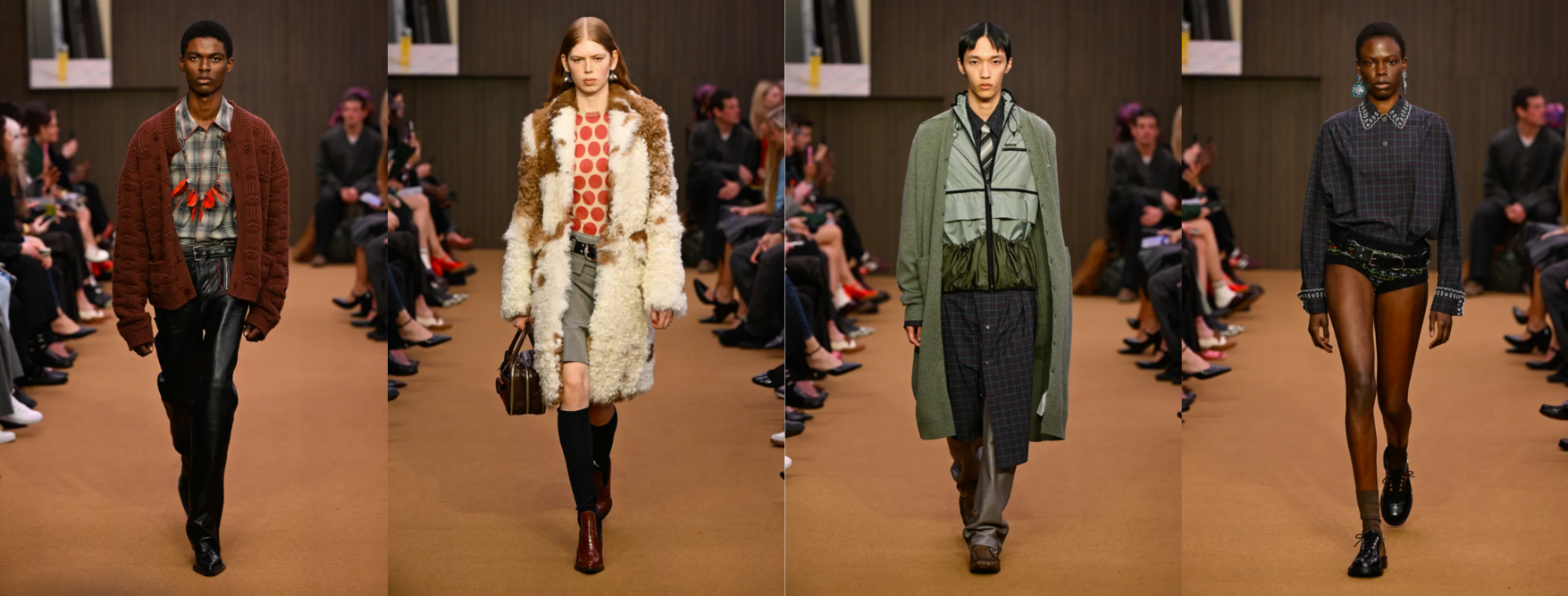

Few houses approach fashion quite like Marni. Throughout its history, the Milan label has resisted the polished precision often associated with Italian luxury, favouring instinct over perfection and emotion over symmetry. Colour, texture and proportion have long carried as much weight as silhouette, giving each collection a sense of spontaneity that has become central to the house’s identity.
Fall/Winter 2026 opened a new chapter as Meryll Rogge presented her first collection for Marni. Instead of redefining that identity, she chose to refine it. The collection remained unmistakably Marni, but its familiar eccentricity unfolded with greater clarity. Unexpected proportions, layered textures and expressive surfaces remained at the heart of the wardrobe, now organised with a confidence that allowed each idea more room to breathe.
From the opening looks, it became clear that silhouette would lead the conversation. Broad shouldered coats tapered gently towards the body, creating generous volume without overwhelming the wearer. Sleeves extended beyond the hand, subtly changing the way garments moved, while asymmetrical dresses shifted the body’s natural balance through layered construction and unexpected cuts. Every look retained an element of surprise, though nothing felt arbitrary.
That measured approach transformed the rhythm of the collection. Instead of competing for attention through a succession of dramatic gestures, each silhouette revealed itself gradually. Construction became something to discover rather than something immediately announced, encouraging a slower reading of the clothes.
Colour carried the same quiet confidence. Earthy browns, forest greens, oxidised reds and muted neutrals grounded the collection in a rich, tactile palette. Brighter shades appeared only occasionally, drawing the eye before fading naturally back into the composition. Their purpose was never to dominate, but to alter the emotional balance of a look with remarkable subtlety.
The same philosophy extended to the materials. Contrasting textures frequently met within a single garment, while layered fabrics, exposed seams and interrupted panels disrupted familiar forms without breaking their harmony. There were moments that recalled the immediacy of an artist’s first sketch, yet every irregularity revealed careful control. Instinct remained visible throughout the collection, though it was supported by craftsmanship of exceptional precision.
What emerged was a version of Marni that felt both familiar and newly focused. Its visual language remained expressive, its colours retained their emotional depth and its silhouettes continued to challenge expectation, but each element contributed to a stronger sense of cohesion. The collection never abandoned the house’s singular character. It simply gave that character greater definition.
At a season where many Milan collections explored refinement through tailoring or material innovation, Rogge proposed another path. Her debut suggested that creativity does not lose its power when it becomes more disciplined. If anything, Marni demonstrated that its distinctive voice becomes even more compelling when instinct is shaped with intention.
May