
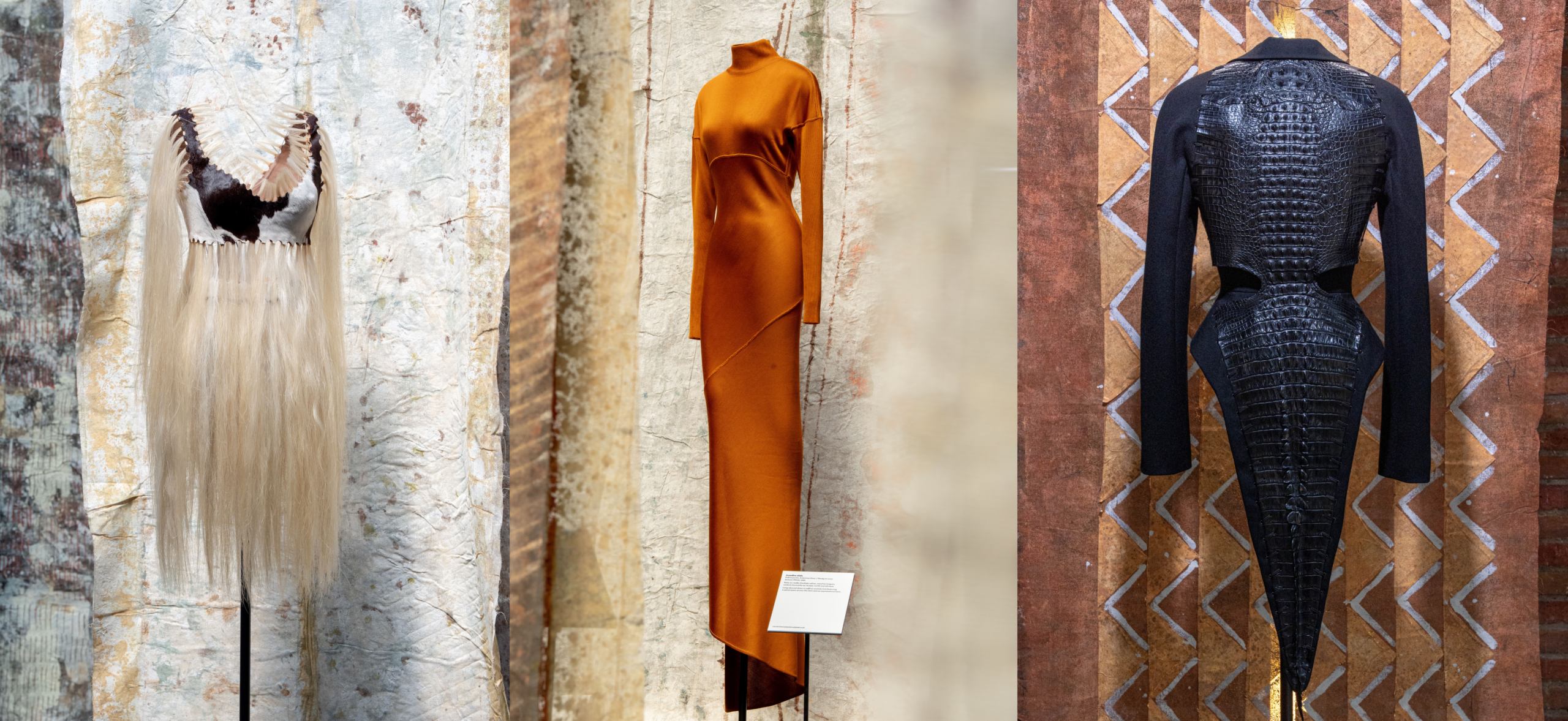

At the Fondation Azzedine Alaïa in Paris, a new exhibition traces the presence of Africa across decades of the couturier’s work, revealing an influence carried through childhood memories, materials, colour and some of his most recognisable experiments with the body.
Azzedine Alaïa made his career in Paris, but part of his visual language had been formed long before he arrived there.
Born and raised in Tunisia, Alaïa left North Africa while still young and eventually established himself within French fashion. Yet the distance did not erase the landscapes, architecture and impressions of his childhood. They resurfaced across decades of work, sometimes through an obvious material or motif, elsewhere in the way light passed through a garment or fabric followed the body.
Azzedine Alaïa et l’Afrique, presented at the Fondation Azzedine Alaïa in Paris from July 7, 2026 to January 4, 2027, gathers these connections for the first time in an exhibition curated by Olivier Saillard. Rather than isolating a single period, it moves through Alaïa’s career to examine how different African references entered his vocabulary, from memories of Tunisia and North African architecture to ancient Egypt, sub-Saharan materials and his encounter with Maasai culture during a journey to Kenya in 1996.
What emerges is not an argument for one easily identifiable « African » aesthetic in Alaïa’s work. The exhibition is more interesting than that. It shows how geography can become personal memory, then gradually lose its literal form as it enters the language of a designer.
Tunisian roots
White is among the first clues.
Openwork cotton dresses and shirts recall the mashrabiyas Alaïa remembered from his childhood in Tunis, architectural screens that filter sunlight while controlling what can be seen through them. In his clothes, that relationship between concealment and exposure moves onto the body. Perforated surfaces allow glimpses of skin while preserving the geometry of the garment, turning an architectural memory into a question of construction.
The white itself carries another association. The Fondation connects Alaïa’s use of luminous cotton with the limewashed walls of his native Tunisia, surfaces whose brightness was part of the visual environment he grew up around. Alaïa translated that impression through fabrics light enough to move with the air, retaining something of the heat and brightness of North Africa without reproducing its architecture literally.
Azzédine Alaïa et l’Afrique
Stéphane Aït Ouarab 2026 – Fondation Alaïa
Other references came through clothing. In his 1992 collection, simple jackets worn over long striped shirts recalled North African menswear, filtered through Alaïa’s own understanding of proportion. These connections are important because they complicate the idea of inspiration as something a designer simply finds elsewhere. Some of Alaïa’s references were already part of him before he became a couturier.
Forms in black
Across the galleries, those luminous whites eventually give way to black, a colour so closely associated with Alaïa that it can be difficult to separate it from the broader image of his work.
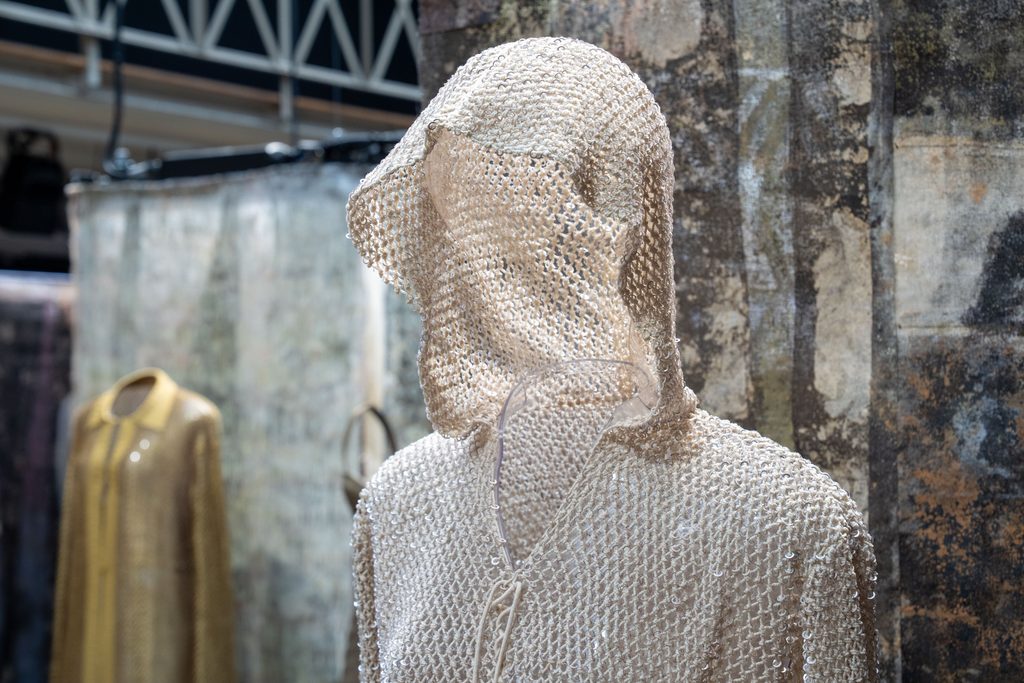
Garments from 1983 and 1984 reveal another dimension. Hoods wrap around the head, fabrics move away from the body and relatively simple constructions acquire their presence through silhouette rather than surface decoration. The Fondation connects this economy of form to Alaïa’s interest in African masks made from leather and dark or burnt woods. Saillard similarly points to an « economy of line » running between Alaïa’s work and the African cultural references that interested him.
The relationship is not always literal, and that ambiguity is one of the exhibition’s strengths. Alaïa did not need to place an identifiable motif on a dress for an influence to survive within it. It could appear through reduction, proportion or the decision to allow a material to determine much of the garment’s character.
Seen in this context, familiar Alaïa signatures begin to look slightly different. His precision around the body remains, but the exhibition introduces other histories into the way that precision developed.
1988, 1989, 1990
Three consecutive Spring/Summer collections provide the exhibition with some of its clearest material evidence.
In 1988, 1989 and 1990, references to sub-Saharan Africa became particularly visible through raffia, twine, shells and cowries, accompanied by a palette moving through sand, earth and intense reds. The archive has yielded pieces including a jacket embroidered with cowrie shells from 1987, while the collections that followed developed these materials across dresses and elaborate surfaces.
These were the collections that initially gave Saillard a clear thread for the exhibition. But his research gradually revealed that the relationship extended much further. As he explained to Vogue, the materials, embroidery and palette were only part of it. Looking through Alaïa’s archive uncovered a broader fascination with African cultures, along with ethnographic masks that had remained largely unknown.
That discovery changes the reading of the exhibition. Instead of presenting three collections built around a recognisable source of inspiration, it asks the visitor to notice how those references continued to surface elsewhere, sometimes clearly and sometimes almost invisibly.
The bandage dress
Few Alaïa designs are more immediately recognisable than the bandage dress, yet the exhibition places its construction within a history that reaches far beyond the body-conscious fashion of the 1980s.
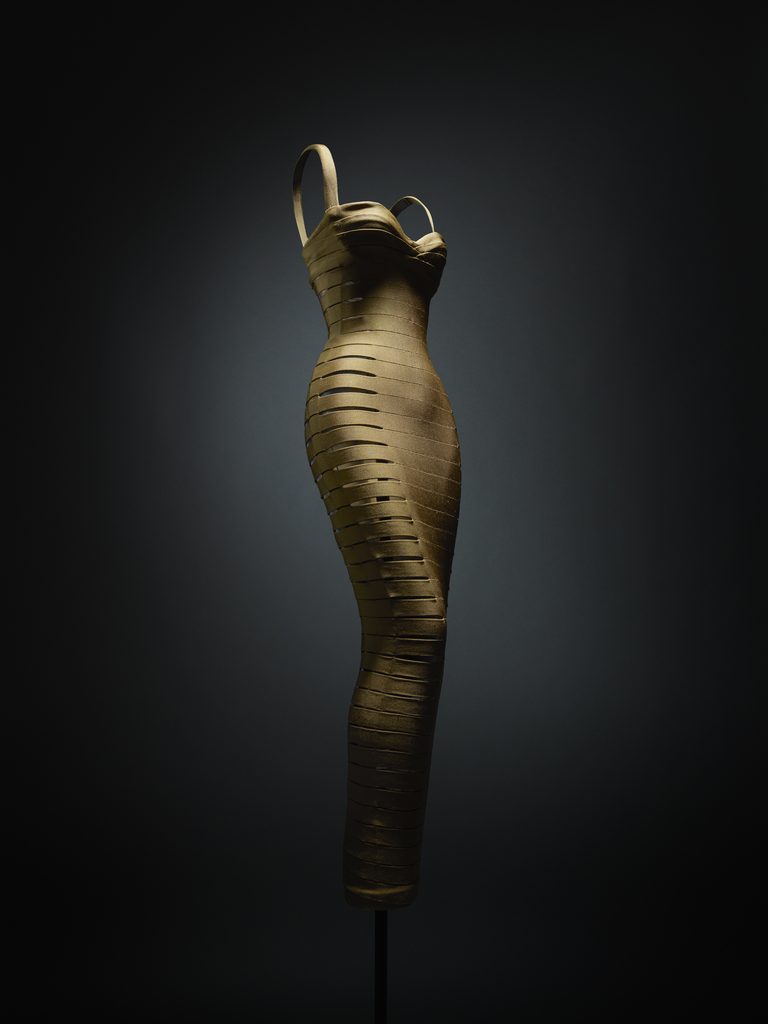
Alaïa was fascinated by ancient Egypt and particularly by the visual language of mummification. The Fondation connects that interest directly to the development of his earliest bandage dresses in 1985, whose narrow sections wrap and articulate the body with extraordinary precision.
The connection is revealing because Alaïa did not simply borrow an Egyptian motif. What interested him was a principle of wrapping, one that could become an exercise in cutting and construction. The reference was absorbed into technique until the resulting garment became unmistakably his.
Azzedine Alaïa
Ready-to-wear, Spring-Summer 1990, Robe à bandelettes
It is a useful example of how Alaïa worked more broadly. Inspiration rarely remained on the surface. Architecture could become openwork, landscape could become colour and an ancient method of wrapping the body could become a new way of constructing a dress.
Kenya, 1996
Alaïa was not known as an enthusiastic traveller. Much of the Africa that existed within his imagination came through memory, books, photographs, objects and the enormous visual culture he accumulated around himself.
That makes his 1996 journey to Kenya particularly significant. Travelling with photographer Peter Beard, Alaïa encountered Maasai culture directly during one of his relatively rare journeys on the continent outside Tunisia. Saillard recalled that the experience overwhelmed him.
The exhibition continues upstairs through Beard’s photographs from that journey, moving away from garments towards a record of Alaïa himself encountering a place that had previously existed largely within a much broader personal and visual imagination. The images do not function simply as documentation. Placed after the clothes, they introduce a distinction between an Africa remembered, researched or imagined and one experienced directly.
That distinction matters, particularly in an exhibition carrying a title as broad as Azzedine Alaïa et l’Afrique. Africa is not treated as a single visual source. Tunisia belongs to Alaïa’s biography, Egypt entered through historical fascination, other regions informed material and colour, while Kenya came through a specific encounter later in his life. The relationships are different, even when the exhibition places them within the same story.
Kris Ruhs in the gallery
Clothes are not alone in the space. Paintings by Kris Ruhs accompany the silhouettes throughout the exhibition, establishing another conversation between Alaïa’s fashion and the art that surrounded his life and work. Their palette moves through sand, earth, orange and deep red, echoing colours found within the garments and the landscapes invoked by the exhibition.
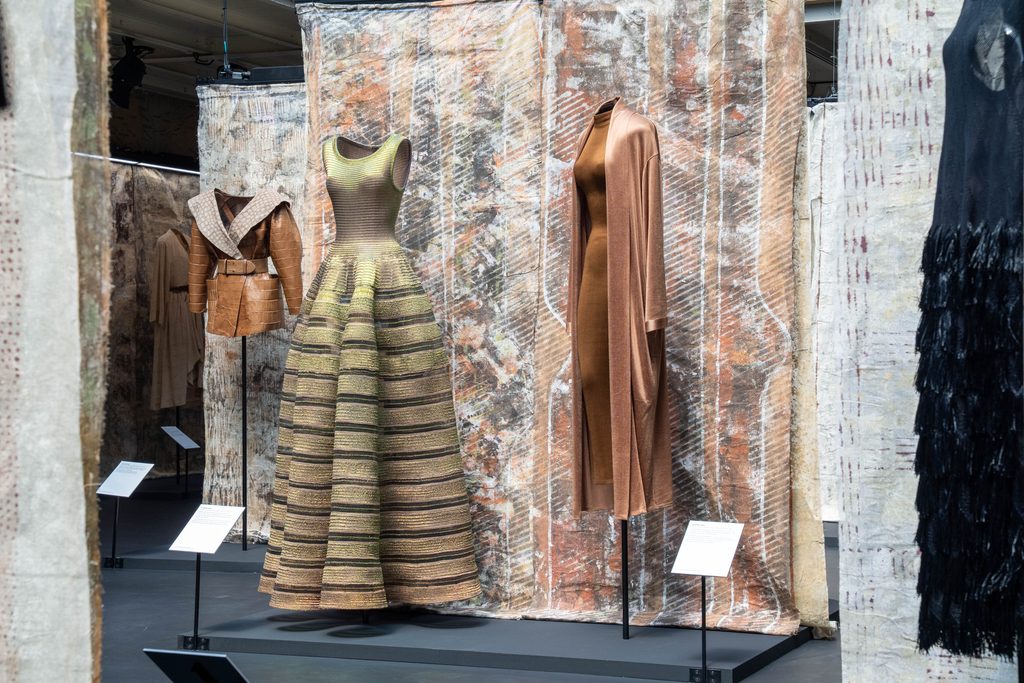
Ruhs was a close creative presence in Alaïa’s world, and here his paintings do more than provide a background. They prevent the clothes from being presented as isolated museum objects, placing them instead within a visual environment where colour and form move between different disciplines.
Azzédine Alaïa et l’Afrique
Stéphane Aït Ouarab 2026 – Fondation Alaïa
The effect suits an exhibition concerned with memory. Rather than attempting to reconstruct the places that inspired Alaïa, the scenography creates its own landscape around the clothes. The result remains interpretative, allowing the garments to carry the evidence rather than surrounding them with literal representations of their references.
A wider perspective
Alaïa’s relationship with the body has dominated much of the critical understanding of his work. His technical command of stretch fabrics, his sculptural training and his ability to construct garments directly around the female form have made that interpretation unavoidable.
Azzedine Alaïa et l’Afrique does not overturn it. Instead, it adds another layer.
The exhibition suggests that some of the qualities regarded as quintessentially Alaïa cannot be understood solely through Parisian couture, technical virtuosity or the women he dressed. His childhood in Tunisia, his fascination with Egyptian history, the objects and images he collected and his interest in cultures across the African continent formed part of the same creative vocabulary.
Perhaps the most revealing aspect of the exhibition is how rarely those influences require explanation once the connections have been made. A perforated white cotton dress remains an Alaïa dress. A black hooded silhouette remains unmistakably his, as does a body wrapped in the narrow bands that became one of his signatures. Learning what sat behind them does not make the clothes less original. It makes visible the memories and references that originality had already absorbed.
For a designer who left Tunisia young and built one of fashion’s most distinctive careers in Paris, Africa was never simply somewhere to return to. Parts of it had travelled with him all along.
May