
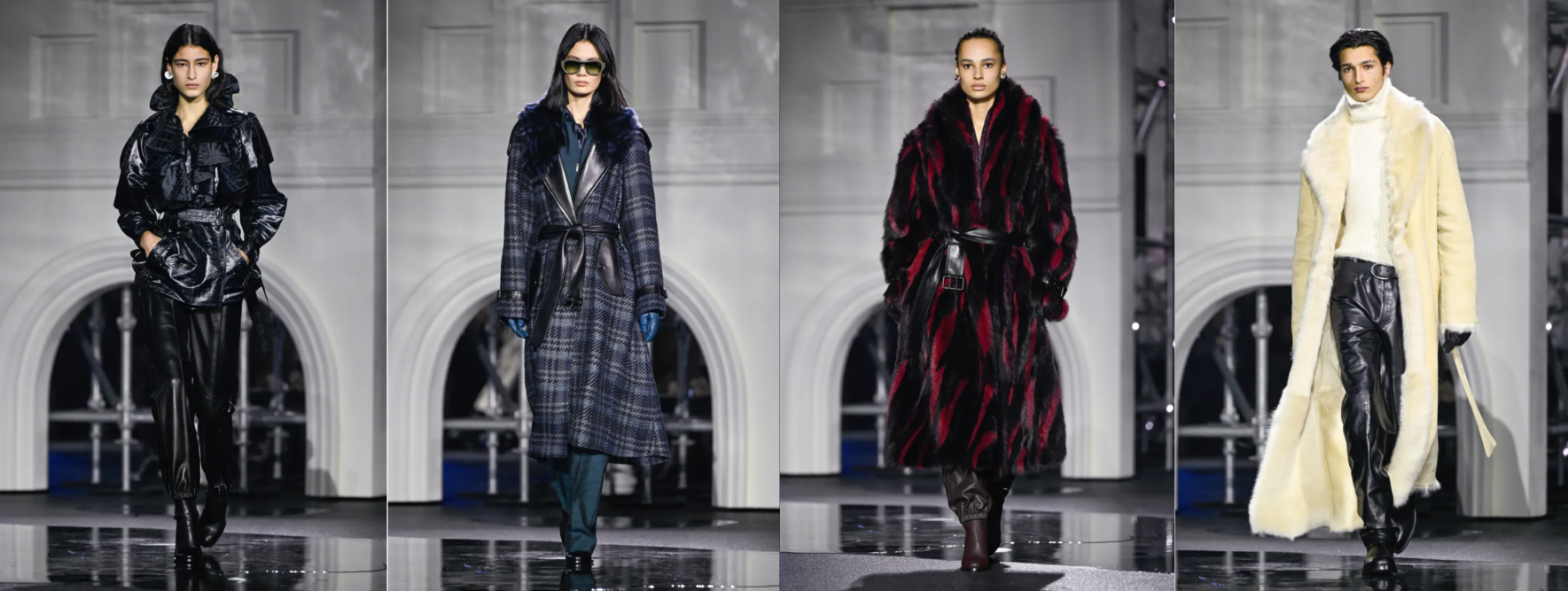

Few garments carry a legacy as closely tied to a fashion house as the trench coat does at Burberry. Designed to protect against the British weather long before it became a symbol of style, it remains the garment through which the house continues to define itself. That heritage has always been present in Burberry’s collections, yet for Fall/Winter 2026 Daniel Lee approached it with unusual precision, choosing not to reinvent an icon but to reconsider the proportions that have shaped it for more than a century.
The trench returned as the collection’s defining presence, though its character had subtly shifted. Longer lines, a slightly raised waist and a softer, more fluid silhouette transformed a familiar garment without compromising its identity. The changes were almost imperceptible in isolation, yet together they altered the balance of the entire collection, suggesting that evolution can sometimes be measured in centimetres rather than concepts.
The coat as the collection’s foundation
Outerwear remained the starting point for almost every silhouette, establishing a rhythm that carried the collection from beginning to end. Coats extended below the knee and were frequently left open, allowing scarves, visible linings and layered tailoring to become integral parts of each look. Belts redirected the eye instead of simply marking the waist, while structured collars framed the face with quiet authority. Even the shoulders, although carefully constructed, avoided rigidity in favour of a silhouette that felt protective without becoming imposing.
Rather than treating the trench as Burberry’s signature piece alone, Daniel Lee used it as the garment around which everything else revolved. It created distance between the body and the fabric, allowing movement to shape the silhouette while preserving the sense of protection that has long defined the house. The result carried an almost architectural quality, achieved not through sharp angles but through careful control of proportion.
Material before decoration
That same measured approach extended to the choice of fabrics. Shades of peat, charcoal, stone and muted olive reinforced the collection’s British identity without relying on familiar clichés, while dense wool, brushed finishes, supple leather and generous shearling gave each look its weight and depth.
Decoration was never entirely absent, but it was rarely the point. Texture became the collection’s primary language, emerging through the interaction of matte and brushed surfaces, the softness of shearling against structured tailoring or the movement created by layered fabrics. Rather than demanding immediate attention, the clothes revealed themselves gradually, rewarding a slower way of looking.
Heritage in motion
Since arriving at Burberry, Daniel Lee has consistently treated the house’s heritage as something that should continue to evolve rather than remain untouched, and Fall/Winter 2026 developed that idea with increasing confidence.
The codes that define Burberry remained unmistakable. Trench coats, traditional tailoring, checks and military inspired outerwear all returned, yet subtle adjustments in cut and proportion quietly reshaped their presence. A longer hem shifted the balance of a silhouette. A repositioned belt altered the movement of a coat. Oversized scarves softened the overall composition without diminishing the structure beneath them.
What emerged was not a rejection of tradition but a demonstration that heritage is never static. Familiar garments acquire new meaning when their proportions change, even if their identity remains intact.
Quiet confidence
Burberry has often occupied a distinctive position within London fashion, balancing respect for tradition with a willingness to evolve. This collection suggested that those two ideas no longer need to exist in opposition.
Nothing here relied on dramatic gestures. Tailoring became softer without losing precision, outerwear gained fluidity without abandoning structure and every adjustment appeared carefully considered rather than designed to surprise. Daniel Lee seemed less interested in asking how far the trench coat could be transformed than in understanding why it has remained relevant for so long.
That may ultimately be the collection’s greatest achievement. Instead of attempting to rewrite Burberry’s history, it demonstrated that the strongest foundations rarely require reinvention. They simply need enough confidence to evolve with time.
May