
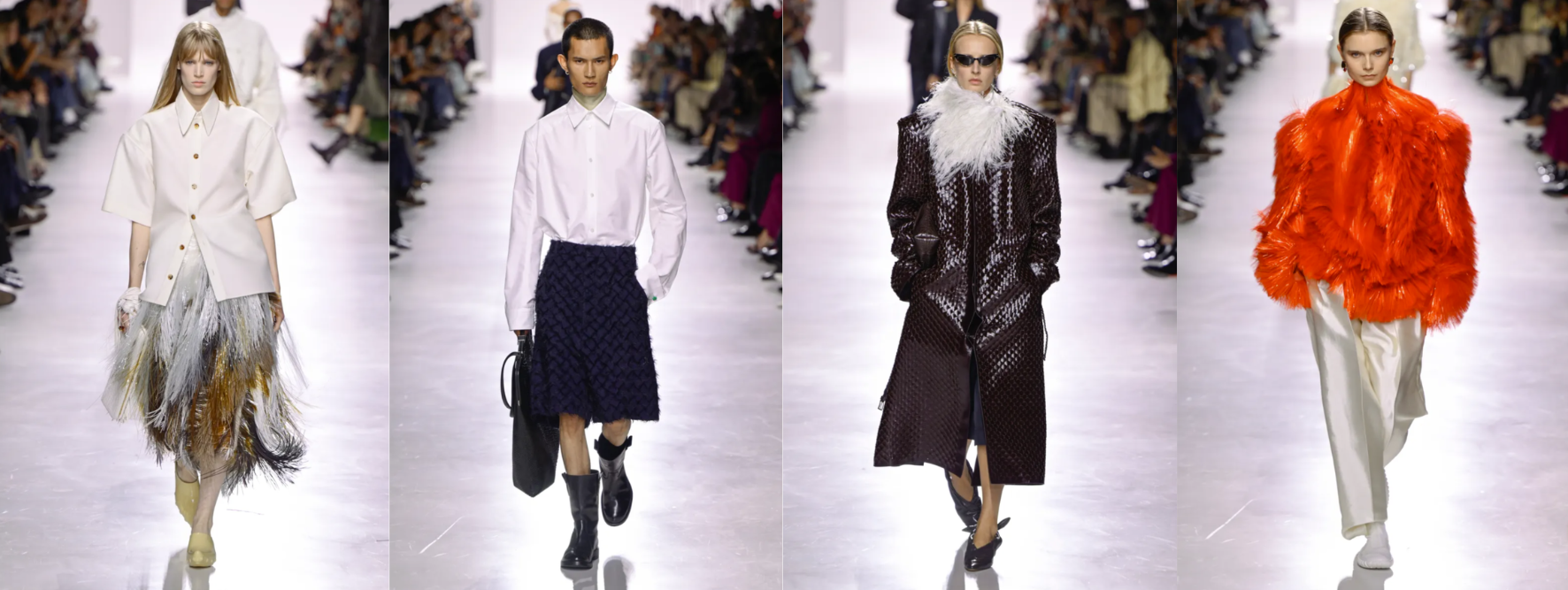

At Bottega Veneta, material has never been treated as a finishing touch. It is where every collection begins. Before a silhouette fully reveals itself, attention is drawn to the grain of a leather coat, the density of a knit or the quiet way light settles across a woven surface. For her debut collection, Louise Trotter embraced that philosophy, presenting Fall/Winter 2026 as an exploration of texture, where material became the collection’s most eloquent form of expression.
Leather naturally anchored the collection, though never in a single, recognisable form. Trotter explored its versatility through contrasting treatments that challenged familiar expectations. Some coats and dresses retained a sculptural presence, their clean construction allowing the leather to stand slightly away from the body with quiet confidence. Elsewhere, the same material softened into fluid drapes and supple folds, moving with an ease more often associated with fabric than hide.
The dialogue between structure and softness remained one of the collection’s defining ideas. Garments that initially appeared rigid gradually revealed flexibility as the models walked, reminding the viewer that craftsmanship can reshape not only a material, but our perception of it.
That conversation continued through knitwear. Dense wool introduced warmth beside the precision of leather, creating subtle contrasts that enriched the silhouette without overwhelming it. Some knits felt compact and architectural, while others opened into looser constructions that invited a closer look. Woven techniques, long embedded in Bottega Veneta’s identity, appeared throughout the collection, dissolving the boundary between garment and object and reinforcing the house’s enduring commitment to artisanal craft.
Layering followed the same philosophy. Leather outerwear rested over substantial knitwear, textured underlayers appeared briefly beneath tailored coats, and different materials met with quiet precision. Depth came not from multiplying garments, but from the conversation unfolding between their surfaces.
From afar, the collection projected remarkable composure. Long coats, measured tailoring and carefully controlled proportions established a calm rhythm that carried through the show. It was only with proximity that another landscape emerged. Grain, weave, subtle creases and shifting finishes revealed themselves gradually, rewarding sustained observation instead of demanding immediate attention. Nothing felt designed for a fleeting image. The richness lay in the details, waiting to be discovered.
That measured confidence shaped Louise Trotter’s first chapter at Bottega Veneta. Rather than pursuing a dramatic break with the past, she chose to deepen the values that have long defined the house, allowing material, construction and technique to guide the collection more than overt styling or theatrical gestures. It was less a declaration of change than an affirmation that Bottega Veneta’s identity continues to evolve through craftsmanship itself.
Seen within the wider context of Milan, the collection offered a distinct perspective on one of the season’s recurring themes. While many designers sought refinement through silhouette or tailoring, Trotter found it in the treatment of material. Fall/Winter 2026 suggested that innovation does not always begin with a new shape. Sometimes it begins with the quiet transformation of a familiar surface, proving that at Bottega Veneta, texture remains one of fashion’s most expressive languages.
May