
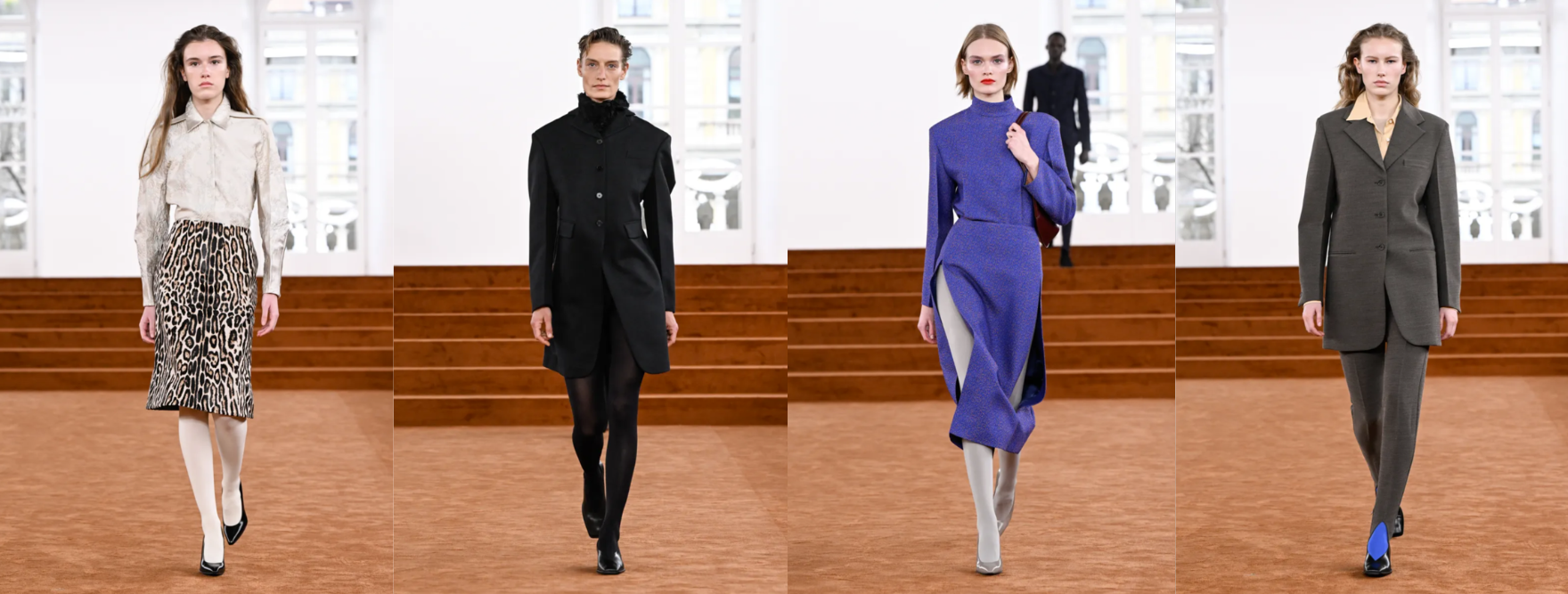

Few houses are as closely associated with minimalism as Jil Sander. Since its founding, the house has built its identity around precision, proportion and an uncompromising attention to material, proving that simplicity can possess as much complexity as ornament.
Fall/Winter 2026 opened a new chapter with Simone Bellotti’s first collection as creative director. His debut never attempted to distance itself from that legacy. Instead, it explored how a familiar visual language can continue to evolve through subtle shifts in texture, construction and movement. The result felt less like a reinvention than the careful beginning of a new conversation.
From the opening looks, Bellotti established a quiet confidence. Long coats drew clean vertical lines across the body, elongated trousers extended the silhouette, while dresses retained the architectural purity long associated with the house. Every proportion appeared deliberate, allowing the garments to command attention without relying on excess or decoration.
Movement gradually became the collection’s defining element. Leather, usually associated with rigidity, followed the body with unexpected fluidity. Tailoring maintained its precision while softening through the shoulders, introducing ease without losing its sharpness. Knitwear added another layer to that dialogue. Slightly irregular textures caught the light as the models walked, revealing that even the most disciplined wardrobe can accommodate nuance and imperfection.
None of these gestures sought to transform Jil Sander overnight. Their strength came from accumulation. Small adjustments in fabrication, silhouette and construction slowly altered the mood of the collection, suggesting that minimalism is not a fixed destination but an evolving practice.
That philosophy extended naturally to the styling. A leopard print skirt emerged unexpectedly among quiet neutrals, while textured knits interrupted the smooth surfaces of tailored wool. These moments never felt provocative for their own sake. They introduced contrast with remarkable control, demonstrating that coherence does not depend on uniformity.
The colour palette echoed the same sensibility. Black, off white, charcoal and warm earth tones absorbed light rather than reflecting it, encouraging the eye to linger on texture, cut and construction before colour itself. Even the richer shades remained understated, reinforcing the atmosphere instead of competing with it.
There was, above all, an awareness of the body that made the collection feel particularly contemporary. Coats moved naturally with the wearer, knitwear followed the silhouette without clinging to it and layered garments preserved their structure while allowing space for movement. The clothes never appeared distant or untouchable. They invited inhabitation, suggesting that precision and comfort no longer need to exist in opposition.
Seen within the broader context of Milan Fashion Week, Bellotti’s debut reflects a wider shift taking place across luxury fashion. Many designers are choosing to deepen established identities rather than replace them, trusting craftsmanship, material and proportion to carry the narrative. Jil Sander offered one of the clearest expressions of that direction. Its future may not lie in pushing minimalism further towards reduction, but in revealing how much richness can emerge from the smallest change.
May