
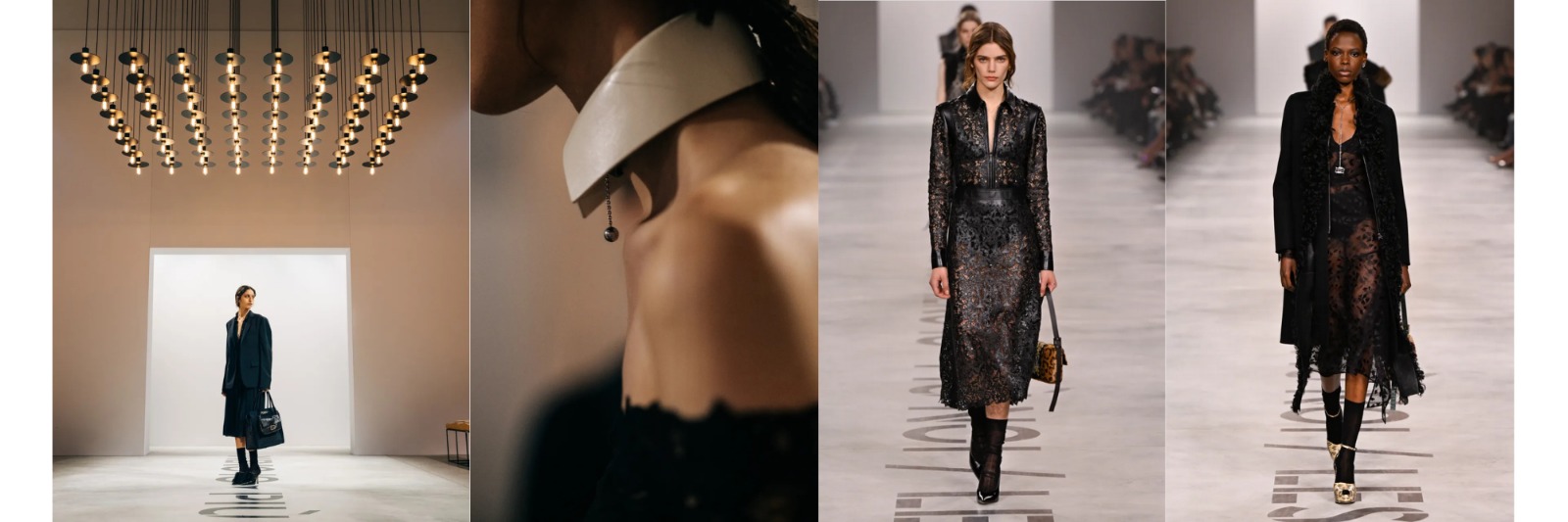

Maria Grazia Chiuri’s first ready to wear collection for Fendi arrived with none of the dramatic gestures that often accompany a creative debut. Presented yesterday during Milan Fashion Week, Fall/Winter 2026 chose continuity over disruption, introducing a quieter evolution of the house rather than a declaration of change.
It was a measured decision at a time when fashion often rewards immediacy. Across recent seasons, exaggerated proportions and headline making moments have become an almost expected part of a designer’s arrival. Chiuri resisted that instinct. Her collection suggested that a house with Fendi’s history does not need to reinvent itself overnight to signal a new direction.
That confidence was evident from the opening looks. Long coats skimmed the body with effortless precision, skirts fell just below the calf and tailoring softened through the shoulders while remaining carefully defined at the waist. The silhouette stayed elongated and uninterrupted, relying on line rather than volume to establish its presence.
Nothing felt amplified simply to command attention. Small adjustments in cut, balance and proportion transformed familiar garments without ever making them feel unfamiliar.
Colour followed the same logic. Shades of stone, ash, espresso and muted ivory established a restrained foundation, occasionally interrupted by deep carmine or flashes of saffron. Those richer tones never altered the rhythm of the collection. They introduced moments of tension that sharpened the eye before quietly dissolving back into the palette.
The result was a collection that found confidence in consistency rather than excess.
Material Intelligence
If the silhouette remained deliberately composed, the materials carried much of the collection’s emotional depth.
Leather, one of Fendi’s enduring signatures, appeared softer than expected. Perforated, moulded and treated to move with the body, it lost much of the rigidity traditionally associated with the material while retaining the technical excellence for which the house is known.
Shearling underwent a similar transformation. Instead of adding weight or volume, it followed the silhouette with remarkable lightness, reinforcing the collection’s interest in fluidity over exaggeration.
Lace, too, played a quieter role. Integrated into the construction rather than applied as ornament, it introduced transparency and texture without disrupting the clean architecture of each look. The same could be said of fur. Long associated with Fendi’s heritage, it framed garments with discretion, acknowledging the house’s history while allowing line and proportion to remain the focus.
That sense of cohesion extended naturally to the accessories. Bags revisited archival shapes with pared back hardware, tall boots lengthened the silhouette and belts defined the waist with a light touch. Every element appeared considered in relation to the whole rather than treated as an individual statement.
The richness of the collection never announced itself immediately. It emerged through the way surfaces caught the light, the softness of a leather coat in motion or the subtle dialogue between contrasting textures. The closer the collection was observed, the more it revealed.
Refining a legacy
Chiuri’s debut never argued that Fendi required reinvention. It suggested something more difficult to achieve, that a house can evolve without abandoning the language that has made it recognisable for decades.
That approach feels particularly relevant within today’s luxury landscape, where collections are often expected to generate immediate visibility beyond the runway. Fendi moved at a different pace. The garments invited attention through construction, fabrication and proportion rather than dramatic gestures designed for a single image.
Nothing about the collection felt simplified. Complexity remained present throughout, but it was carefully organised, allowing silhouette, material and tailoring to support one another instead of competing for attention.
In that sense, control became less a limitation than a creative discipline.
A quieter confidence
Fendi has long occupied a distinctive place within Italian fashion through its understanding of materials and technical construction. Chiuri’s first collection preserves that identity while subtly shifting its tone.
Rather than responding to a landscape increasingly shaped by visibility and constant novelty, she proposed a wardrobe built on continuity. It is an approach that asks for patience, rewarding closer observation instead of immediate impact.
Seen alongside the collections presented in London only days earlier, Fendi reflects a broader movement emerging this season. Across different fashion capitals, several designers appear less interested in rewriting established identities than in refining them, demonstrating how familiar house codes can acquire new meaning through thoughtful adjustment rather than radical change.
Whether that tendency comes to define Fall/Winter 2026 remains to be seen. Yet Chiuri’s debut establishes a clear direction, one built not on breaking with the past, but on understanding why it continues to matter.
May