
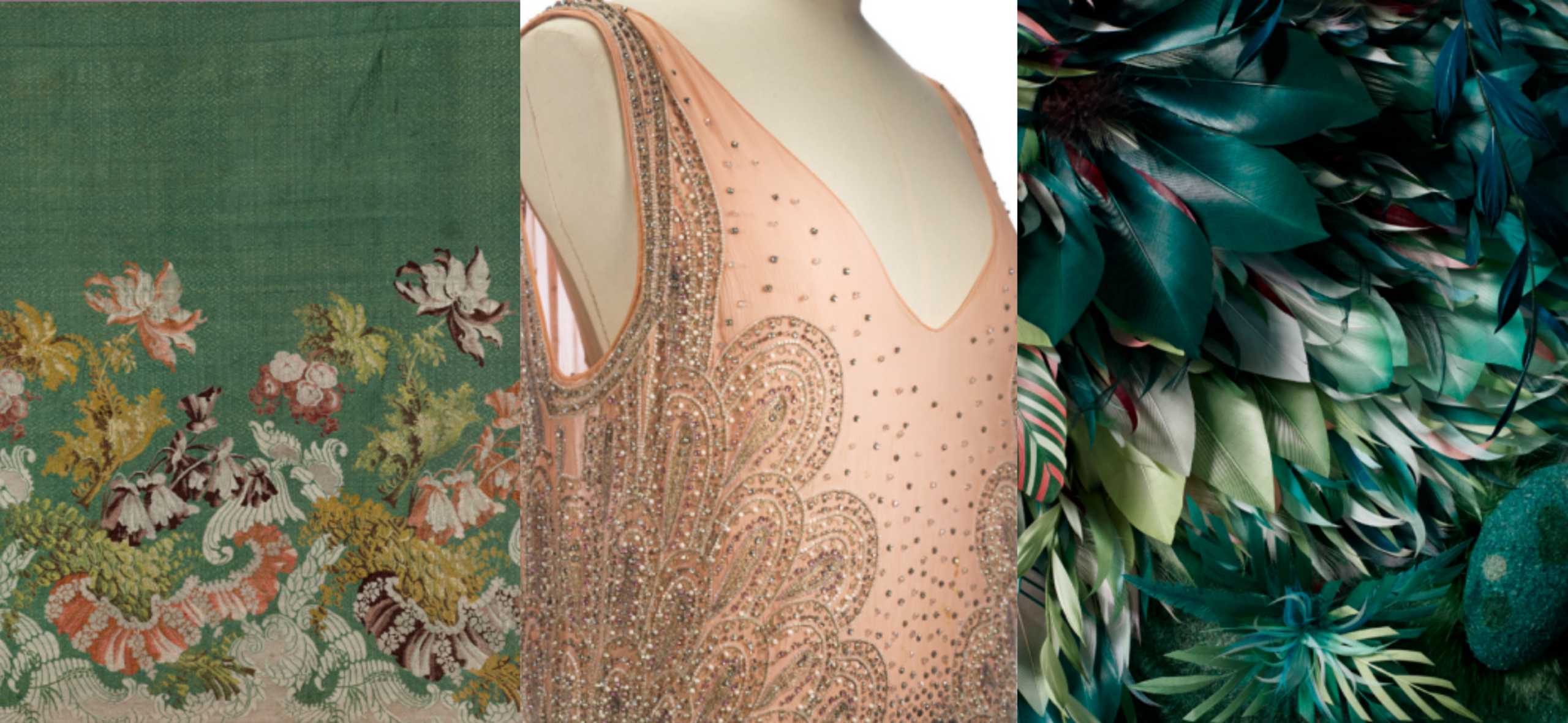

Craft, technique, mastery, these are words that that usually point to heritage, to preservation, to something already known.
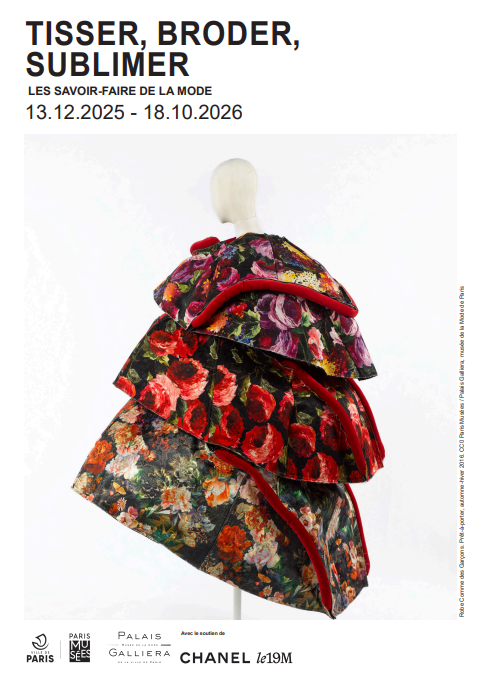
But at Palais Galliera, the exhibition Tisser, broder, sublimer : les savoir-faire de la mode gently shifts that expectation.
The focus isn’t on finished pieces but on everything that leads up to them.
Before form
The exhibition unfolds as the first chapter of a broader reflection on fashion savoir-faire, spanning from the 18th century to today.
What it reveals is a layer we rarely pay attention to. Before silhouette, before image, there is transformation.
Threads are assembled into surfaces, surfaces are reworked through repetition and motifs appear slowly, through accumulation.
More than 350 works, oscillating between textiles, fragments, tools and documents, trace these processes across time.
Fashion doesn’t begin with an idea but with a gesture.
The flower, reconsidered
At the centre of the exhibition is a familiar motif: the flower.
But here, it isn’t treated as decoration.
Across centuries, floral forms have structured textile creation — woven directly into fabric, constructed through embroidery, or shaped by hand into artificial elements.
The flower becomes a kind of language:
- repeated within the weave
- constructed through thread
- assembled into volume
It doesn’t sit on the surface, it actively participates in how the material is built.
Surface transforms structure
Embroidery, lace, passementerie, printing, dyeing, the range of techniques on display is extensive.
From a distance, they might appear as decorative but up close, that distinction no longer holds.
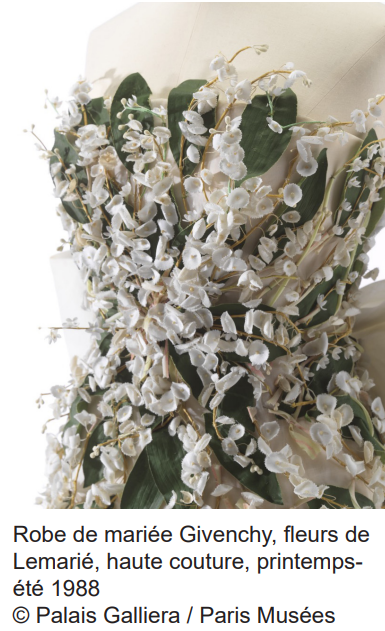
Beads add weight to the fabric
Threads pull, tighten, redirect.
Density changes how a piece moves, how it falls, how it resists.
These techniques aren’t just there to embellish but also to alter behaviour and, in some cases, it becomes the structure itself.
A well built chain
What emerges throughout the exhibition is not a single act of creation, but a sequence.
Each technique relies on another. Each step extends the previous one.
Behind every piece is a network of specialised ateliers, embroidery houses, feather workers, textile makers, each forming an ecosystem that remains essential to fashion today.
Nothing exists in isolation.
Clothing doesn’t appear all at once.
It takes shape through a chain of operations, often invisible in the final result.
In motion
The exhibition moves across time, bringing together historical objects, couture pieces, and contemporary works among which some were created specifically for this context.
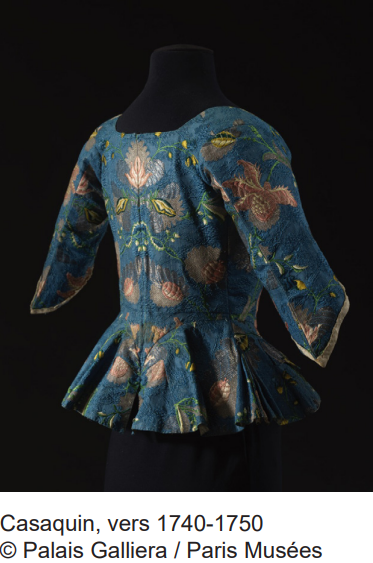
That coexistence matters more than we could think.
It shows that these techniques aren’t fixed in the past, they continuously shift, adapt and keep being reinterpreted.
Savoir-faire isn’t something to preserve intact, it’s something that evolves.
As the exhibition suggests, form often follows technique. Not the other way around.
Learning to look again
The more complex the technique, the easier it is to overlook.
From a distance:
- embroidery becomes shimmer
- weaving becomes texture
- labour dissolves into surface
The exhibition slows things down by bringing you closer and changing the scale of your attention.
What comes forward is no longer the image, but the making behind it.
Closing note
Tisser, broder, sublimer doesn’t try to impress. It works more quietly.
It shifts the way you look, from surface to process, from appearance to construction and once that shift happens, it’s hard to go back.
Fashion no longer reads as something immediate, it becomes something built, layer after layer.
A form of material intelligence, shaped over time.
May