
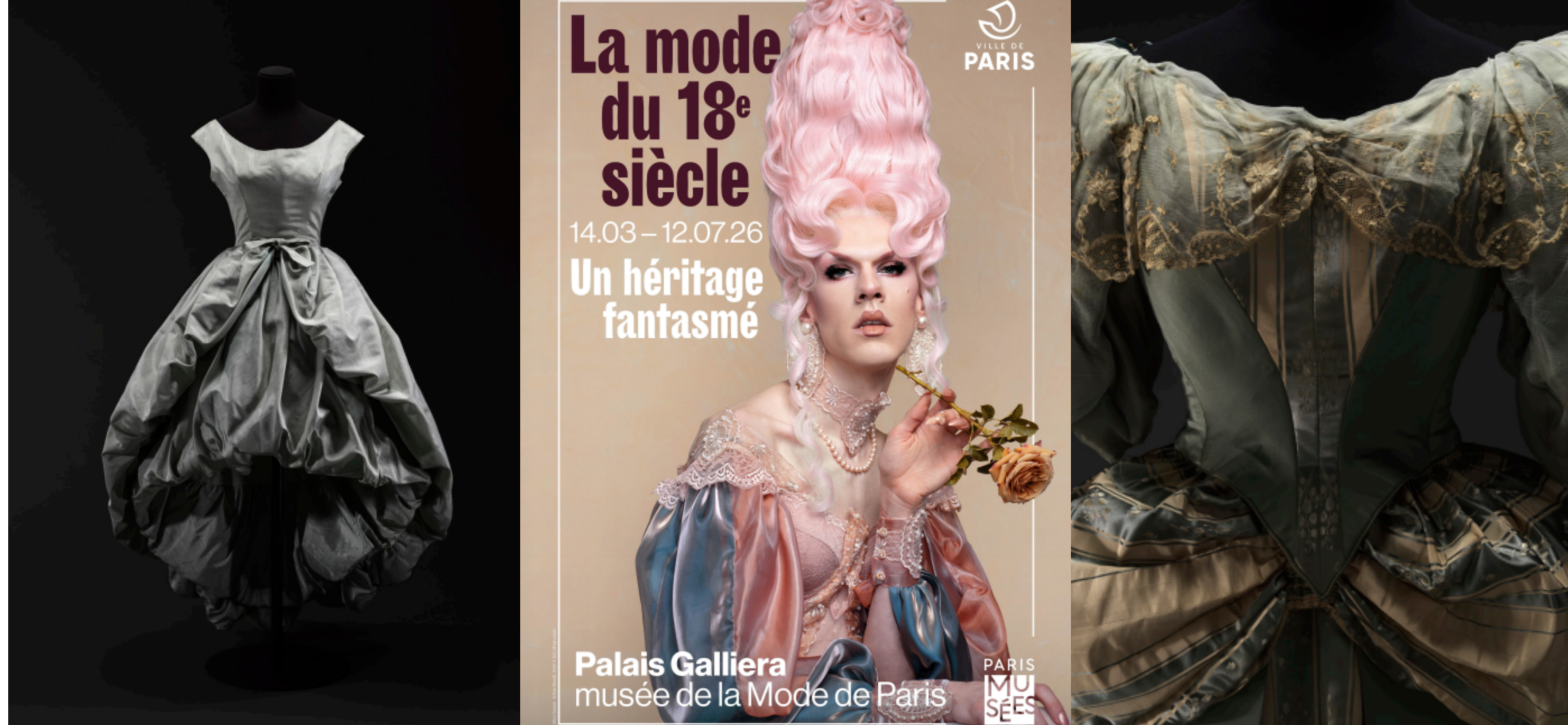

There is something deceptively familiar about 18th-century fashion. Corsets, panniers, elaborate fabrics, powdered hair and ornament have become so recognisable that they can almost be read at a glance. They appear across cinema, photography, contemporary collections and popular culture, often long after the historical context that produced them has disappeared.
La Mode du XVIIIe siècle : un héritage fantasmé, presented at the Palais Galliera from March 14 to July 12, 2026, begins with that familiarity and gradually complicates it. Bringing together more than 70 silhouettes with accessories, textiles, graphic works and photographs, the exhibition moves across three centuries to examine not only how women dressed during the Age of Enlightenment, but how later generations learned to imagine the period.
Its subject, in other words, is as much memory as fashion.
Reconstructing the 18th century
Our understanding of 18th-century fashion has never depended solely on the garments that survived it. Paintings, engravings and portraits preserved one version of the period, while theatre, cinema, photography and fashion gradually constructed another. Over time, the two became increasingly difficult to separate.
Certain details have consequently acquired the power of visual shorthand. Pastel colours, lace, flowers, corsetry or an elaborate wig can evoke an entire century without reproducing it with any particular accuracy. We recognise the image before necessarily understanding its origin, partly because generations of reinterpretation have made it familiar.
At Galliera, this distance between historical reality and collective memory is not presented as something that needs to be corrected. Instead, the exhibition treats reinterpretation as part of fashion history itself, tracing how the image of the 18th century was constructed long after the century had ended.
First revival
That process began earlier than contemporary fashion might suggest. From the Second Empire onwards, the 19th century developed its own fascination with the aesthetics of the Enlightenment, returning to an imagined world of refinement and aristocratic elegance at a moment marked by considerable political and social change.
Historical accuracy was never entirely the point. Designers selected recognisable elements from the previous century and adapted them to contemporary tastes, transforming historical dress as they revived it. What later generations inherited was therefore already a reinterpretation, shaped as much by 19th-century ideas about the past as by the 18th century itself.
The relationship continued into the following century. After the Second World War, French haute couture drew once again on the techniques and savoir faire associated with 18th-century luxury as Paris sought to reinforce its position internationally. Dior’s New Look became one particularly influential expression of that return to historical proportions, while later designers continued to revisit corsetry, panniers, elaborate surfaces and the controlled volumes of period dress.
Architecture around the body
Before these forms became references, they were remarkably precise constructions. Historical garments reveal just how deliberately 18th-century dress could alter the body’s proportions, using internal structures and layers to create silhouettes that bore little resemblance to its natural shape.
Panniers extended skirts horizontally, sometimes to extraordinary widths, while corsets organised the torso according to a carefully controlled line. Fabric, undergarments and construction worked together to determine how the wearer stood, moved and occupied the space around them. These clothes did not simply follow the body. They established the shape the body was expected to assume.
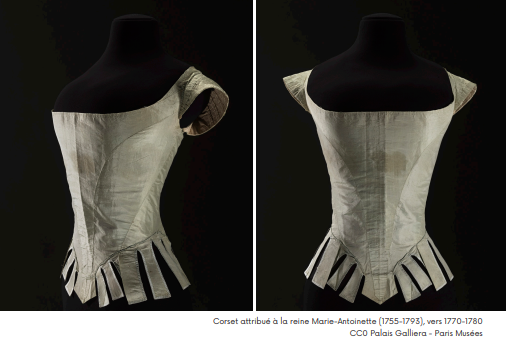
Seen at close range, the relationship between beauty and engineering becomes difficult to separate. Silk, embroidery and ornament may command attention first, but underneath lies an architecture of support, tension and proportion. Among the exhibition’s most significant objects is an exceptionally fragile corset from a grand dress attributed to Marie Antoinette and dated around 1770 to 1780, placed on rare public display for the occasion.
It is in objects like this that the distance between historical clothing and its romanticised image becomes particularly clear. Collective memory tends to preserve the beauty of the silhouette, while the garment itself reveals the complex construction required to produce it.
Dressing for the gaze
Dress belonged to a highly codified social environment in the 18th century. Fabrics, ornament and silhouette communicated wealth and position, while the dimensions of clothing influenced something more immediate, the way an individual physically occupied a room.
The width of a pannier created presence but imposed distance too. Structured garments affected posture and movement, while elaborate surfaces turned the dressed body into something designed to be observed. Clothing participated in the performance of social identity through appearance, but equally through the physical behaviour it required from its wearer.
That context becomes particularly important when these silhouettes are compared with their later reinterpretations. The shapes that contemporary fashion repeatedly borrows were once embedded in specific systems of hierarchy and etiquette. Removed from those conditions, they became available for entirely different meanings, allowing designers to retain the visual language while rewriting what it could express.
Reinventing the reference
By the late 20th and early 21st centuries, designers no longer needed to reproduce 18th-century clothing faithfully for the reference to remain immediately recognisable. Its vocabulary had become familiar enough to survive being fragmented, exaggerated or taken almost entirely out of context.
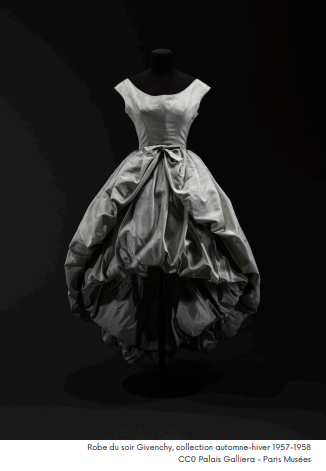
Designers have returned to the 18th century again and again. Sometimes faithThe exhibition places historical garments in conversation with later creations by houses and designers including Chanel, Christian Dior, Louis Vuitton, Christian Lacroix, Vivienne Westwood and Dries Van Noten. Their approaches differ considerably, yet each demonstrates how historical forms can acquire new meanings when transported into another period.
Corsetry can become a tool of provocation rather than convention. Panniers can be enlarged until their original function gives way to abstraction, while decoration once associated with aristocratic refinement can be transformed through camp, kitsch or queer expression. The reference remains visible, but its meaning is no longer fixed to the world that created it.
This is where the idea of un héritage fantasmé becomes particularly relevant. Fashion does not need to reproduce history accurately in order to keep it present. A proportion, a surface, a construction technique or even a familiar gesture can be enough to carry an image of the past into another generation.
Reading the past
La Mode du XVIIIe siècle : un héritage fantasmé is not an exercise in nostalgia. Its interest lies in the distance between a historical period and the image that eventually survives it.
Across three centuries, the same visual language has been admired, romanticised, reinterpreted and sometimes deliberately distorted. Each return has added another layer, until historical reference and cultural fantasy have become almost impossible to separate. The 18th century survives in contemporary fashion not because it was preserved intact, but because successive generations continued to find something within it worth transforming.
Perhaps that is why these silhouettes still feel so familiar. When fashion looks back, it rarely encounters the past alone. It encounters everything that has already been imagined about it, then adds another version of its own.
May