
Positioned between January’s menswear collections and the major European fashion weeks that follow, London has long occupied a distinctive place within the fashion calendar. It rarely sets the dominant narrative for the season. Instead, it introduces ideas that gradually gain momentum, offering designers the freedom to explore new directions before they reach a wider audience.
That role remained unmistakable throughout Fall/Winter 2026, although its expression felt noticeably different. The collections favoured clarity over excess, allowing construction, proportion and material to shape each narrative with quiet confidence. London did not become less experimental. It simply found new ways to express that instinct through precision instead of provocation.
As the week unfolded, a common thread emerged. Fashion was not stripped back or simplified. It became more intentional, with craftsmanship and silhouette carrying much of the emotional weight.
The evolving silhouette
Silhouette became one of the week’s defining languages, not through dramatic exaggeration but through the way garments directed movement and organised the body.
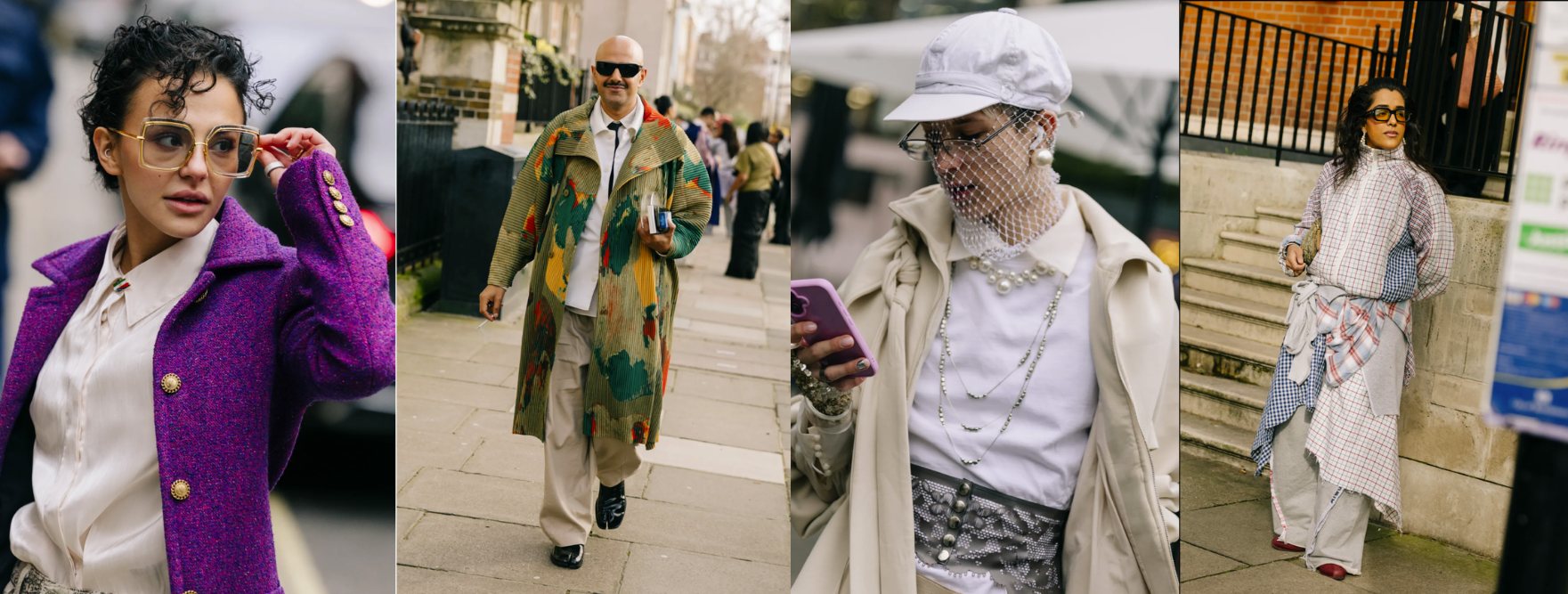
Coats fell well below the knee, creating elongated vertical lines that carried the eye through each look. Trousers either gathered softly over footwear or finished with crisp breaks at the ankle, leaving little room for ambiguity. Elsewhere, skirts layered over trousers and tailoring appeared less as unexpected styling choices than as natural extensions of the silhouette itself.
Structure remained present throughout the collections without becoming rigid. Shoulders held their shape, waists emerged through cut rather than compression, while high collars and elongated lapels reinforced the continuous flow of each look. Small adjustments in proportion proved capable of transforming an entire silhouette, demonstrating how carefully measured design can often achieve more than dramatic intervention.
Material as expression
Fabric carried an equally important role, giving garments their character long before embellishment entered the conversation.
Dense wool, brushed textures, leather, shearling and weighty knitwear brought depth through their inherent qualities, allowing craftsmanship to reveal itself in the making of the garment rather than through decoration. Texture became a form of expression in its own right.
Even transparency took on a different role. Tulle, lace and organza rarely stood alone, instead gaining substance through layers that anchored their lightness. Movement remained, but it was balanced by a stronger sense of structure, giving even the lightest fabrics a lasting presence.
Colour followed the same measured approach. Charcoal, peat, stone, muted greens and earthy neutrals dominated much of the week, creating space for texture and proportion to take precedence. When richer tones appeared, they deepened the atmosphere instead of demanding attention, reinforcing the quiet confidence that defined many collections.
Experimentation through refinement
London has always built its reputation on challenging convention, but this season suggested that innovation no longer depends on disruption alone.
Designers increasingly directed their attention towards construction, where subtle shifts in proportion and carefully considered layering became more compelling than overt conceptual gestures. A sleeve extending beyond expectation, a coat whose length altered the body’s balance, or translucent fabrics accumulating into sculptural forms often left a stronger impression than any single dramatic statement.
Nothing about the week suggested that London had abandoned its experimental spirit. If anything, it revealed a growing confidence in allowing ideas to unfold with patience, trusting precision to create impact where provocation once dominated.
A season finding its direction
Viewed alongside the menswear collections that opened the year and the couture presentations that followed in Paris, London appeared to reflect a broader shift taking place across the international calendar. Designers seemed less interested in constant reinvention than in refining the visual languages they had already established, returning to proportion, construction and material as the primary tools of evolution.
That movement could be seen across several of the week’s most notable collections. Burberry revisited the trench coat without distancing it from the house’s heritage. Simone Rocha gave softness greater presence through construction and carefully controlled volume. Erdem looked back at his own archive, allowing memory to evolve instead of preserving it unchanged.
Together, those collections suggested a city growing into its own confidence. London no longer felt compelled to prove its creativity through disruption alone. It demonstrated that fashion can remain adventurous while embracing precision, craftsmanship and thoughtful design.
As the season continued through Milan and Paris, that question extended beyond the British capital. Was this simply London’s direction, or the beginning of a wider shift across fashion? Fall/Winter 2026 hinted that refinement may become one of the year’s defining ideas, not as a retreat from creativity, but as a different way of expressing it.
May