

The Quiet Evolution of Minimalism
Minimalism has always been the language of Jil Sander.
A language built on clarity, on control, on the refusal of excess.
But like any language, it shifts over time. It absorbs new tensions, new sensitivities. It learns to soften certain edges while sharpening others.
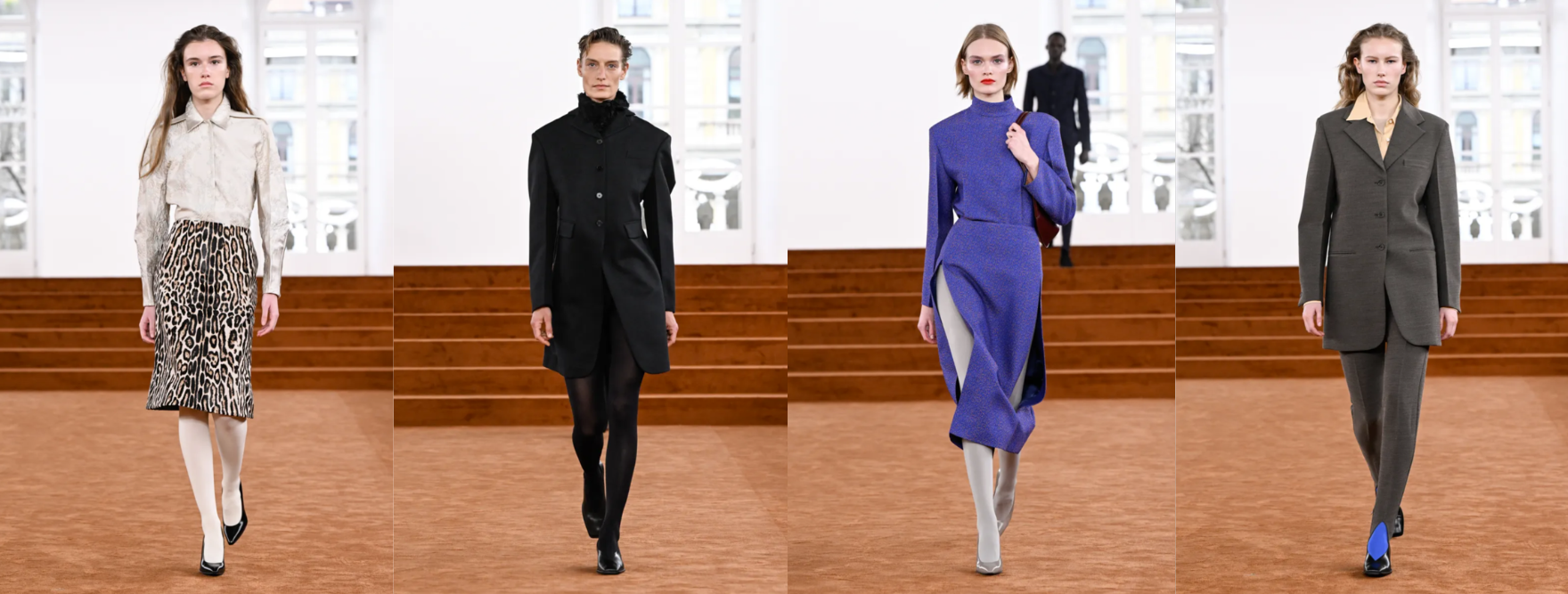
This season in Milan, that evolution was almost imperceptible at first glance. The silhouettes remained anchored in what the house does best: long, linear coats falling close to the body, narrow trousers extending the line rather than breaking it, dresses cut with an almost architectural precision. Nothing distracted from the structure. Nothing attempted to seduce through drama.
And yet, something had undeniably changed.
It was in the way the clothes moved.
Leather, usually associated with rigidity, carried an unexpected fluidity. Coats didn’t impose themselves on the body, they followed it. Knitwear, often perfectly controlled in past seasons, introduced slight irregularities, almost invisible shifts in texture that caught the light differently as the wearer walked. Tailoring, while still exact, felt less strict. Shoulders softened. Lines loosened just enough to suggest comfort without ever tipping into casualness.
There was a sense that the garments had learned to breathe.
This subtle release of tension did not mean a loss of discipline. On the contrary, it made the precision more noticeable. When everything is controlled, nothing stands out. But when control is selectively relaxed, each decision becomes visible.
And then came the interruptions.
A leopard-print skirt, fleeting but deliberate, appeared within a sequence of restrained neutrals. Not as provocation, but as punctuation. A textured knit disrupted the smooth continuity of a wool coat, creating friction between surfaces. These moments were brief, almost easy to miss, but they carried an unmistakable weight.
They suggested that minimalism, here, is no longer about purity but about calibration.
The palette remained largely grounded, blacks, off-whites, dense neutrals absorbing rather than reflecting light. When variation appeared, it did not brighten the mood. It deepened it. The clothes did not ask to be looked at. They required attention.
There was also something more human in this collection.
Not in an expressive or emotional sense, but in the way it acknowledged the body as something that moves, shifts, exists over time. The slight relaxation in tailoring, the softness of materials, the quiet disruptions, all pointed toward a minimalism that is lived in, not imposed.
Jil Sander didn’t abandon its foundations this season but adjusted them.
And in doing so, it reminded us that restraint is not static. Instead, it is something that can evolve, almost silently, until suddenly, it feels entirely new.
May