
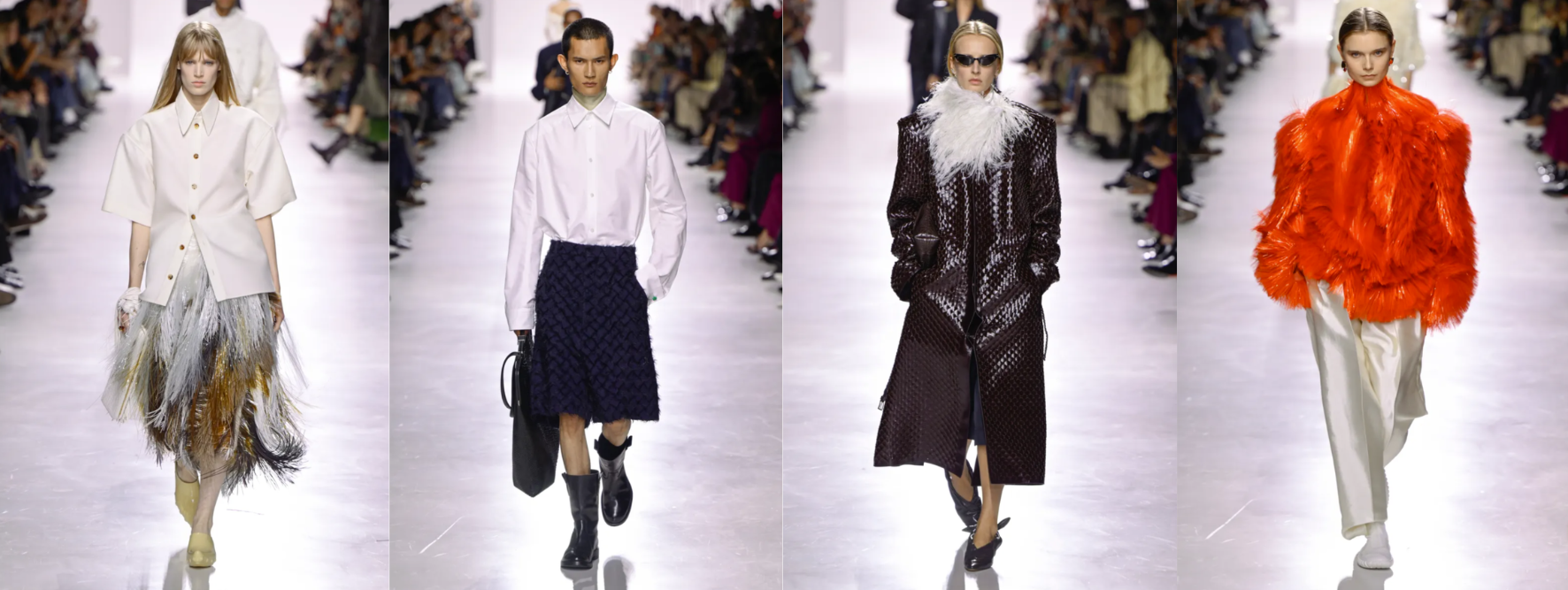

Language of Textures
At Bottega Veneta, fabric has never been a passive element—it leads, it shapes, it defines. Long before a silhouette fully reveals itself, there is always the surface, the hand, the way light settles (or resists settling) on a garment. This season in Milan, that philosophy felt more pronounced than ever. Texture didn’t just support the collection—it was the collection’s language.
Leather, inevitably, stood at the center. But rather than presenting it as a single, recognizable signature, the house explored it almost like a spectrum. Some pieces were engineered with a near-architectural precision: coats with firm shoulders, dresses that held their structure away from the body, as if suspended. These looks felt deliberate, controlled—almost sculptural in their stillness.
Then came the contrast. Leather that moved. That bent and folded with a softness more commonly associated with jersey or silk. Skirts that shifted with each step, outerwear that wrapped rather than imposed. It created a subtle dissonance—the eye expects rigidity, but the body experiences fluidity.
Knitwear deepened this dialogue. Thick, tactile wool surfaces interrupted the sleekness of leather, introducing friction in both texture and perception. Some knits appeared densely packed, almost compressed, while others felt more open, as if stretched or pulled. There were moments where materials seemed to merge—woven constructions that blurred the line between garment and object, between clothing and something closer to design.
Layering played a quiet but important role. Not in a maximalist sense, but in how pieces interacted: a leather shell over a dense knit, or a textured underlayer peeking through a more restrained exterior. These combinations added depth without overwhelming the eye.
From afar, the collection read as composed, almost restrained. The silhouettes were clean, measured, and relatively calm—no exaggerated theatrics, no unnecessary volume. But as the looks approached, that restraint dissolved into intricacy. Surfaces revealed themselves as complex, almost topographical—creases, weaves, finishes, each demanding attention.
What made the show resonate was this tension: simplicity versus complexity, distance versus proximity, control versus movement. It never felt forced. There was no need to amplify or dramatize.
Nothing shouted for attention.
But everything held it—just long enough to make you look twice, and then a third time, noticing something new each time.
May