

Control as Strategy
Yesterday at Milan Fashion Week, a shift became visible.
Not a rupture or a reinvention, nothing that announced itself with urgency. Under the creative direction of Maria Grazia Chiuri, Fendi presented its Fall/Winter 2026 collection. Not by attempting to reset the conversation but by making it feel like an internal adjustment. A recalibration of scale, of material, of density and emphasis that felt deliberate.
For the past few years, fashion has operated at full volume. Bigger silhouettes, louder gestures, collections designed to circulate instantly, to translate into images before they even settle into memory. Fendi could have continued in that direction. It has the vocabulary for it, the history, the authority.
Instead, Chiuri compressed the energy.
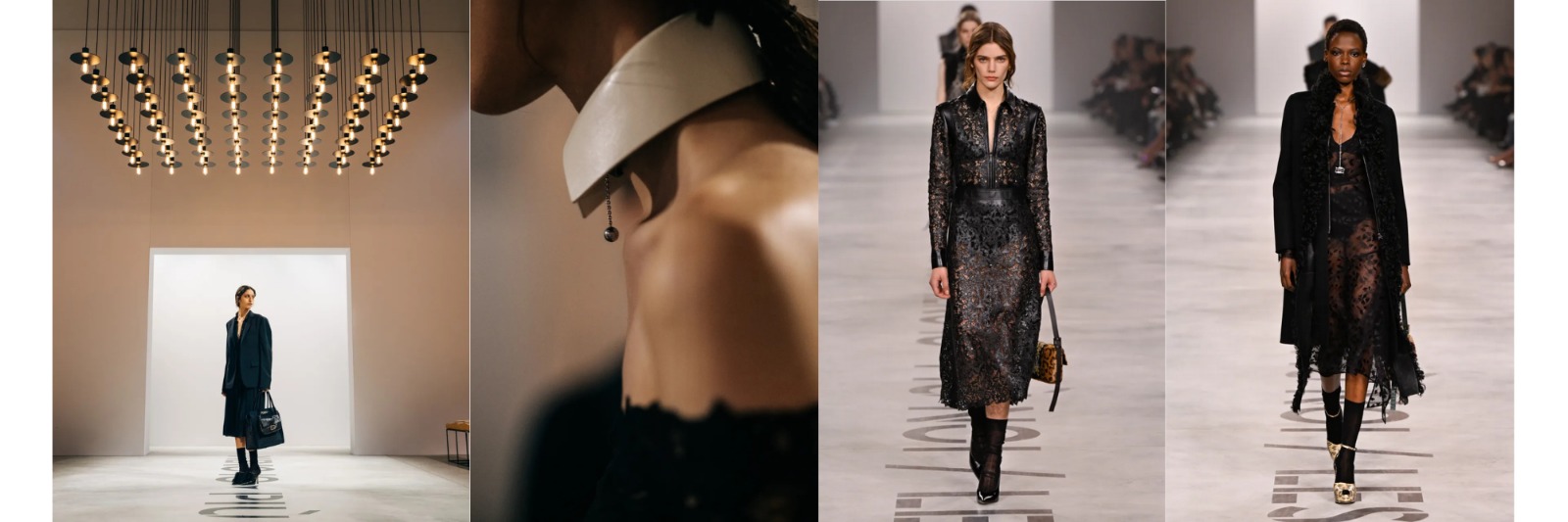
The first exits set a clear rhythm: elongated coats cut close to the body, skirts grazing mid-calf, tailoring softened at the shoulder but precise through the hip. Nothing inflated. The silhouette stayed vertical, uninterrupted, almost disciplined in its refusal to expand.
There was no inflation, no theatrical volume.
And that control wasn’t cold. It was measured. The kind that comes from knowing exactly how far something needs to go, and stopping there.
The palette reinforced that position. It moved through mineral neutrals — stone, ash, espresso, and muted ivory, interrupted only occasionally by deep carmine and sharp flashes of saffron, not decorative, but assertive. A punctuation mark rather than an accent.
The message was subtle but strategic: luxury does not need to occupy space aggressively to assert itself. It can hold its ground quietly, and still feel undeniable.
Material Intelligence
The collection’s strength lay in fabrication. If the silhouettes were restrained, the materials carried the complexity.
Leather, a Fendi signature, was reworked with precision. Thinned, perforated, molded into shapes that felt almost weightless. It moved with the body rather than imposing structure onto it. There was something unexpectedly fluid in the way it caught the light.
Shearling, too, was reconsidered. Shaved down, reduced, almost aerodynamic. It no longer built volume. It traced it.
Even lace, traditionally associated with softness or decoration, was treated differently. It appeared embedded within garments, interrupting surfaces rather than embellishing them. It didn’t romanticize. It structured.
And then there was fur, impossible to ignore in the context of Fendi. This season, it felt controlled, contained. Less about presence, more about line. It framed the body instead of dominating it.
There was a consistent logic throughout: materials were not there to be seen first. They were there to be understood over time.
Accessories followed that same discipline. Bags leaned into archival shapes, stripped of excess hardware. Boots stretched high and narrow, extending the vertical line of the silhouette. Belts reappeared, gently marking the waist without breaking the flow.
Nothing fought for attention. Nothing begged to be photographed.
In a market driven by instant imagery, this didn’t appear as neutrality but as positioning.
Chiuri’s debut proposes a slower gaze. A wardrobe that reads in person before it performs on screen. It suggests that the next phase of Fendi may prioritize continuity over virality.
After the noise
Fendi has always existed in a space between technical mastery and material sensuality. That balance remains.
What shifts here is the emotional register.
We are coming out of a period where fashion equated visibility with relevance. Where exaggeration guaranteed algorithm’s attention. Where collections were designed to be consumed quickly, almost before they could be experienced.
The expected move would be to go further. Louder, sharper, more immediate. To intensify display.
Instead, this debut signals a retreat from that logic.
Rather than rewriting the house codes, Chiuri appears to be tightening them, aligning heritage with a contemporary desire for coherence. She Removes what is unnecessary without stripping away identity. The result is not minimalism, not quite. It is precision.
In a saturated luxury landscape, expansion is easy. Precision is harder.
This debut does not scream “new era” but suggests a shift in posture.
Fendi is not chasing momentum here. It is consolidating it. Narrowing its focus in a landscape that rewards expansion.
And in a system saturated with noise, that narrowing begins to feel like power.
May