
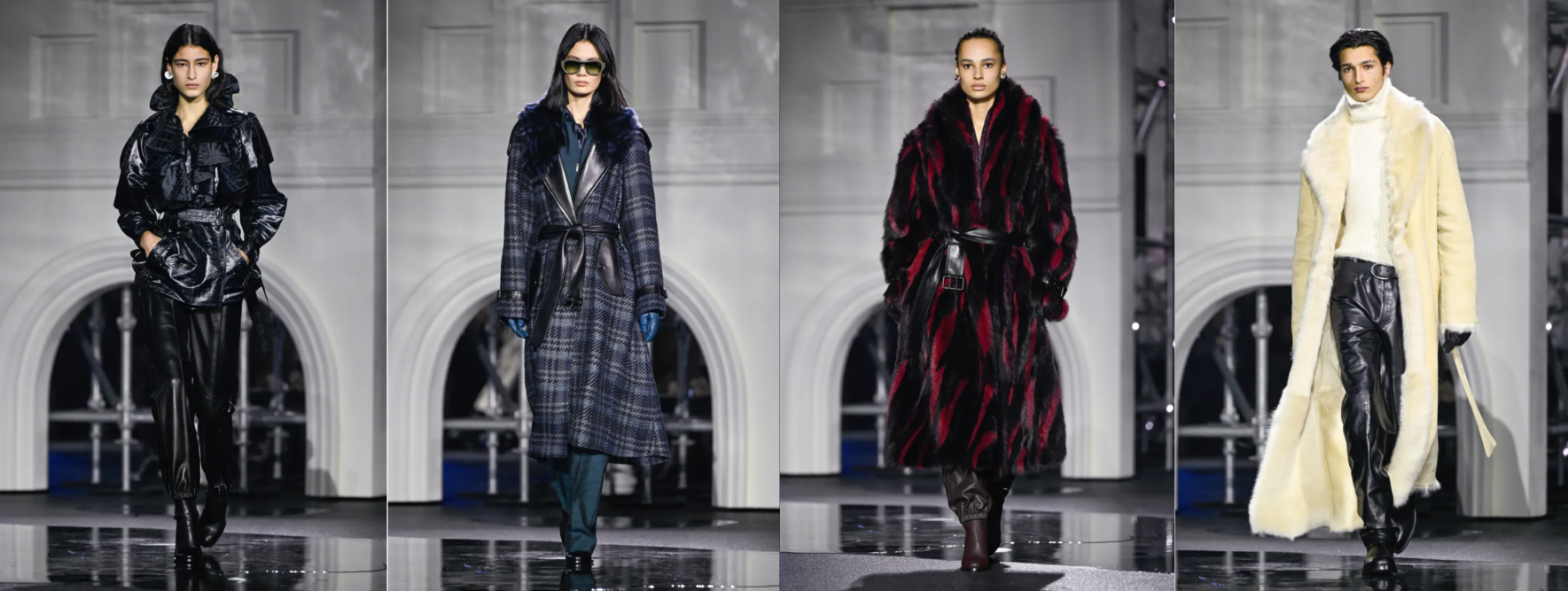

Rewriting the Trench
At Burberry, protection was not introduced as a theme. It was already there, embedded in the foundation.
This season in London did not attempt to romanticize the house’s heritage. It refined it, almost quietly. The trench returned, as expected, but without nostalgia attached to it. It felt recalibrated rather than revisited. Lengthened lines, a waist slightly lifted, proportions adjusted just enough to shift the entire silhouette.
Nothing dramatic.
But nothing neutral either.
The gesture was restrained. The effect, precise.
The Coat as Framework
Outerwear carried the collection without needing to assert it.
Coats extended below the knee, often left open, creating a continuous vertical line that moved with the body. The inside was never hidden, it remained part of the composition. Belts didn’t cinch in a traditional sense, they redirected the eye. Collars framed the face with a kind of quiet authority. Shoulders held their structure but never imposed it.
The trench stopped being a reference piece.
It became a framework.
A way to organize the body, to establish distance between fabric and skin, to define a silhouette without enclosing it. There was something almost architectural in that approach. Not rigid, but deliberate.
Protection, here, was constructed rather than declared.
Surface Without Excess
The palette moved through grounded tones, peat, stone, charcoal, muted olive. Colours that didn’t seek attention but held presence.
Fabric carried more weight than design intervention.
Wool felt dense but never heavy. Leather absorbed light instead of reflecting it. Surfaces remained matte, controlled, almost quiet. Nothing shimmered, nothing tried to pull focus.
There was no need for ornament.
Material replaced embellishment. Texture replaced emphasis.
The restraint did not flatten the collection. It sharpened it.
Heritage, Reinvented
Burberry did not attempt a reinvention this season.
It worked through adjustment.
The familiar codes remained intact, check, trench, tailoring, but they were reweighted. A slight shift in proportion altered the reading of a coat. A longer line changed the way the body occupied space. Nothing relied on contrast or disruption.
Everything relied on control.
Protection, in this context, was not defensive. It was compositional.
The coat didn’t shield from the outside world.
It shaped the figure within it.
A Recalibrated Identity
London has always existed in tension, between heritage and experimentation, between tailoring and disruption.
This season, that tension didn’t disappear. It settled.
Distortion became quieter. Romantic gestures felt grounded. Experimentation remained, but contained within structure rather than breaking away from it.
Nothing collapsed.
Nothing pushed to extremes.
There was a sense of composure, not as an aesthetic choice, but as a working method.
If earlier moments sketch direction, this one defined weight.
London did not try to redefine itself.
It refined its outline.
May