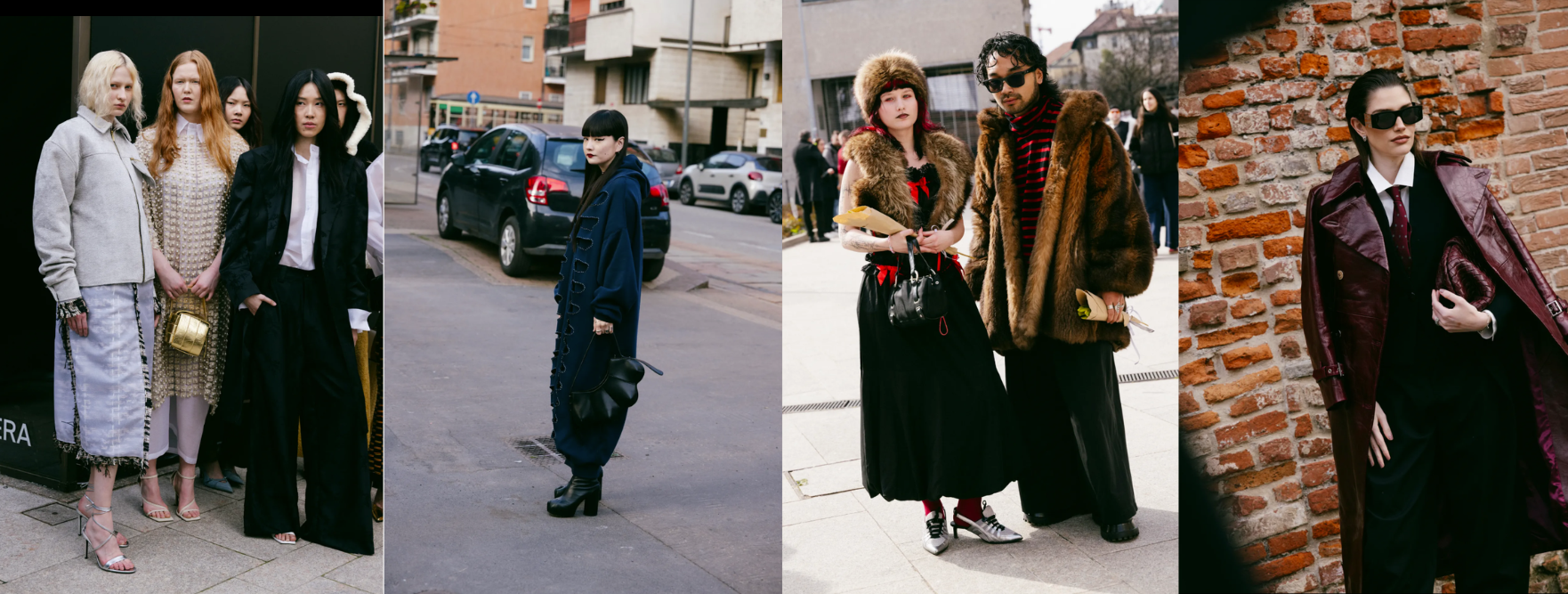

Fashion weeks are often remembered through individual moments. A striking silhouette, an unexpected casting choice or the closing look of a major house can easily dominate the conversation. Yet once the pace slows, another picture begins to emerge. The collections stop competing for attention and start speaking to one another.
That was particularly true in Milan this season. Rather than producing one defining statement, Fall/Winter 2026 unfolded through a series of shared ideas that surfaced across houses with very different identities. Designers returned to similar questions of proportion, construction and material, though each answered them in their own way.
These were not trends in the conventional sense. They were recurring principles that quietly shaped the season from one runway to the next.
1. Verticality replaced volume
After several seasons dominated by oversized proportions, Milan shifted the focus towards length. Designers favoured silhouettes that guided the eye vertically, allowing garments to extend naturally rather than expand outward.
Long coats fell close to the body, dresses reached the ankle with uninterrupted lines and tailoring relied on proportion instead of exaggerated volume. At FENDI, Gucci and Jil Sander, presence came through precision rather than scale.
The effect was neither severe nor nostalgic. These elongated silhouettes introduced a quiet confidence, proving that impact does not always depend on occupying more space.
2. Layering became part of the garment
Layering is often treated as a matter of styling. In Milan, it became something far more structural.
At Prada, shirts extended beneath dresses and outerwear, jackets remained partially visible beneath coats, while skirts were worn over trousers in ways that transformed the silhouette itself. Each layer carried a specific function within the garment’s overall composition instead of existing as an optional addition.
Other collections explored similar relationships between garments, suggesting that complexity can emerge through careful construction rather than accumulation. Dressing itself became an architectural exercise, where every element contributed to balance, rhythm and proportion.
3. Materials carried the narrative
Many collections found their strongest expression not through decoration but through the character of their materials.
Leather, wool, knitwear and technical fabrics shaped garments long before embellishment entered the conversation. At Bottega Veneta, leather shifted effortlessly between sculptural structure and remarkable fluidity, revealing how a familiar material can take on entirely different identities through craftsmanship alone. Elsewhere, dense wools, textured knits and carefully balanced fabric combinations created depth without relying on ornament.
The material was no longer supporting the design. In many cases, it became the design.
4. Black sharpened the eye
Black appeared throughout the week, though rarely as a dramatic statement in itself.
At Dolce & Gabbana, monochrome looks directed attention towards lace, tailoring and construction instead of colour. Across other collections, deep neutrals created a similar effect, encouraging the eye to notice subtle variations in texture, cut and proportion that might otherwise have gone unnoticed.
Rather than reducing visual interest, the limited palette heightened it. By removing the distraction of bold colour, designers allowed craftsmanship and silhouette to speak with greater clarity.
5. Heritage evolved through refinement
Perhaps the week’s most revealing theme lay in the way established houses approached their own histories.
Instead of pursuing radical reinvention, many designers chose to deepen the languages already associated with their brands. House codes remained recognisable, but they were reconsidered through adjustments in proportion, fabrication and construction rather than sweeping change.
Maria Grazia Chiuri approached her first collection for FENDI through continuity instead of rupture. At Jil Sander, Simone Bellotti built on the house’s established vocabulary with measured confidence, while Louise Trotter’s debut at Bottega Veneta extended the brand’s long standing dialogue with material and craft. Even Gucci, presenting a studio designed collection between creative directors, favoured coherence over disruption.
The result was a season in which heritage felt active rather than fixed. Milan suggested that a house’s identity is rarely strengthened by abandoning its past. More often, it grows through a deeper understanding of the ideas that have sustained it over time.
Looking beyond the season
Seen individually, these shifts might appear almost imperceptible. Together, they reveal a season shaped by careful adjustment rather than dramatic transformation. Across Milan, designers repeatedly returned to proportion, material, construction and craftsmanship, placing renewed confidence in the foundations of fashion itself.
Whether these ideas continue to influence the seasons ahead remains to be seen. What Fall/Winter 2026 made clear is that fashion does not always move forward through rupture. Sometimes its most lasting changes begin quietly, as familiar ideas are revisited with greater precision, greater confidence and a renewed sense of purpose.
May